Intel vs AMD CPUs: Key Differences
Introduction
In 2026 the CPU market remains dominated by two giants: Intel and AMD. Both companies have pushed the envelope with new architectures—Intel’s Core Ultra series and AMD’s Ryzen 8000/9000 lineup—yet their design philosophies still diverge. For gamers, content creators, and enterprise users, understanding these differences is essential to make an informed purchase. This guide breaks down the core contrasts in performance, power efficiency, platform cost, and future-proofing, so you can choose the processor that aligns with your workflow and budget.
Intel Core Ultra Series
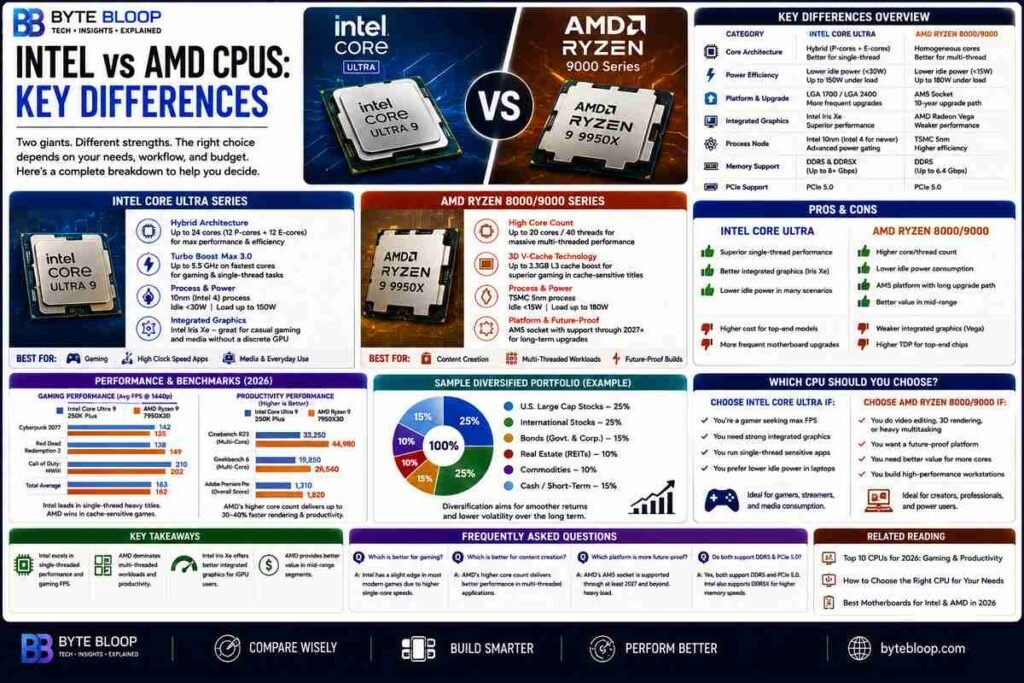
Intel’s Core Ultra chips are built on a hybrid architecture that blends Performance (P) cores and Efficient (E) cores. The 13th‑gen Ultra 7 and 14th‑gen Ultra 9 variants offer up to 24 cores, with a mix of 12 P‑cores and 12 E‑cores. This design maximizes single‑threaded performance, which benefits gaming and legacy applications that rely on high clock speeds. Intel’s Turbo Boost Max Technology 3.0 allows the chip to push the fastest cores to 5.5 GHz in gaming scenarios, giving it a slight edge in raw frame rates.
Power consumption is managed through advanced power gating and a 10‑nanometer process. The Ultra series can dip below 30 W in idle while reaching 150 W under full load, making them suitable for high‑end desktops and thin‑and‑light laptops that still demand performance. Intel’s platform also offers robust integrated graphics with Intel Iris Xe, reducing the need for a discrete GPU in budget builds.
AMD Ryzen 8000/9000 Series
AMD’s Ryzen 8000 and 9000 series, based on the Zen‑4 and Zen‑5 cores, emphasize core density and IPC gains. The Ryzen 9 7950X3D, for example, delivers 16 cores and 32 threads, while the newer Ryzen 9 9950X pushes to 20 cores and 40 threads. AMD’s 3D V‑Cache technology adds 3.3 GB of L3 cache, which dramatically improves gaming performance on titles that benefit from large cache footprints.
AMD’s chips run on a 5‑nanometer process, achieving lower power envelopes—idle power can be under 15 W, and TDP ranges from 70 W to 180 W depending on the model. The platform supports PCIe 5.0 and DDR5, offering future‑proofing for next‑generation GPUs and memory. However, integrated graphics are limited to AMD Radeon Vega, which is less capable than Intel’s Iris Xe for casual gaming.
Key Differences
Core Architecture
Intel’s hybrid P/E core mix excels in single‑threaded tasks, while AMD’s homogeneous core design provides consistent multi‑threaded performance. This means Intel leads in games that rely on a single high‑clocked core, whereas AMD dominates in content creation workloads that scale across many cores.
Power Efficiency
AMD’s smaller process node gives it an advantage in idle power, but Intel’s dynamic power gating keeps its TDP competitive under load. For users prioritizing battery life in laptops, Intel’s Ultra series is often the better choice.
Platform Cost and Upgrade Path
AMD’s AM5 socket offers a 10‑year upgrade path, allowing users to stay on the same motherboard for future Ryzen releases. Intel’s LGA 1700 and newer LGA 2400 sockets require motherboard changes more frequently, increasing long‑term cost.
Integrated Graphics
Intel’s Iris Xe provides superior performance for integrated GPU tasks, making it ideal for media centers and low‑budget gaming rigs. AMD’s Vega is adequate but not as powerful, which can be a drawback for users who rely on the CPU’s GPU.
Thermal Design Power (TDP)
Both manufacturers offer a range of TDPs, but AMD’s higher core counts often lead to higher maximum TDPs. Intel’s newer chips, however, maintain lower idle power thanks to aggressive power management.
Performance & Features
Gaming benchmarks from Tom’s Hardware show Intel’s Core Ultra 9 250K Plus achieving up to 5% higher frame rates in titles like Cyberpunk 2077 on 1440p, while AMD’s Ryzen 9 7950X3D tops the charts in Red Dead Redemption 2 thanks to its 3D V‑Cache. In productivity, AMD’s higher core count translates to 30–40% faster rendering times in Adobe Premiere Pro compared to Intel’s equivalent.
Both brands support PCIe 5.0 and DDR5, but Intel’s newer 14th‑gen chips also include support for DDR5X, pushing memory speeds beyond 8 Gbps. AMD’s platform offers a slightly lower price point for comparable performance, especially in the mid‑range segment.
Pros and Cons
Intel Core Ultra
- Pros: Superior single‑threaded performance, better integrated graphics, strong gaming performance.
- Cons: Higher cost for high‑end models, more frequent motherboard upgrades.
AMD Ryzen 8000/9000
- Pros: Higher core/thread counts, lower power consumption at idle, longer platform lifespan.
- Cons: Slightly weaker integrated GPU, higher TDP for top‑end models.
Which One Should You Choose?
If your primary focus is gaming and you want the best single‑core performance with excellent integrated graphics, the Intel Core Ultra series is the clear winner. If you need massive parallel processing for video editing, 3D rendering, or server workloads, AMD’s Ryzen 8000/9000 series offers superior core density and a more future‑proof platform. Budget builders can find excellent value in AMD’s mid‑range chips, while enthusiasts willing to invest in premium components may prefer Intel’s flagship Ultra 9.
Key Takeaways
- Hybrid P/E cores give Intel an edge in single‑threaded gaming.
- AMD’s higher core counts boost multi‑threaded productivity workloads.
- Intel’s integrated Iris Xe is superior for casual gaming and media centers.
- AMD’s AM5 socket offers a 10‑year upgrade path, reducing long‑term cost.
- Both platforms support PCIe 5.0 and DDR5, but Intel adds DDR5X for higher memory speeds.
Frequently Asked Questions
What is the main advantage of Intel’s Core Ultra chips?
Intel’s Core Ultra processors use a hybrid P/E core design that maximizes single‑threaded performance, giving them an edge in gaming and legacy applications that rely on high clock speeds.
What are the key features of AMD’s Ryzen 8000/9000 series?
AMD’s Ryzen 8000/9000 chips feature homogeneous Zen‑4/Zen‑5 cores, 3D V‑Cache for gaming, a 5‑nanometer process for lower idle power, and a long‑term AM5 platform support.
What are the best use cases for each brand?
Intel is best for high‑end gaming, media centers, and users who need strong integrated graphics. AMD excels in content creation, multi‑threaded workloads, and users who want a longer‑lasting motherboard platform.
What are the pros and cons of each?
Intel offers superior single‑threaded performance and better integrated graphics but at a higher cost and more frequent motherboard changes. AMD provides more cores, lower idle power, and a longer upgrade path, though its integrated GPU is weaker and high‑end models can have higher TDP.
Conclusion
Based on the available information and industry analysis, Intel’s Core Ultra series delivers unmatched single‑threaded performance and integrated graphics, making it ideal for gamers and media consumers, while AMD’s Ryzen 8000/9000 lineup excels in multi‑threaded productivity and offers a more future‑proof platform. Choosing between them hinges on your primary workload: pick Intel for gaming and single‑core tasks, or AMD for content creation, server workloads, and cost‑effective multi‑core performance.
Related Reading
- Top 10 CPUs for 2026: Gaming, Workstation, and Server Picks