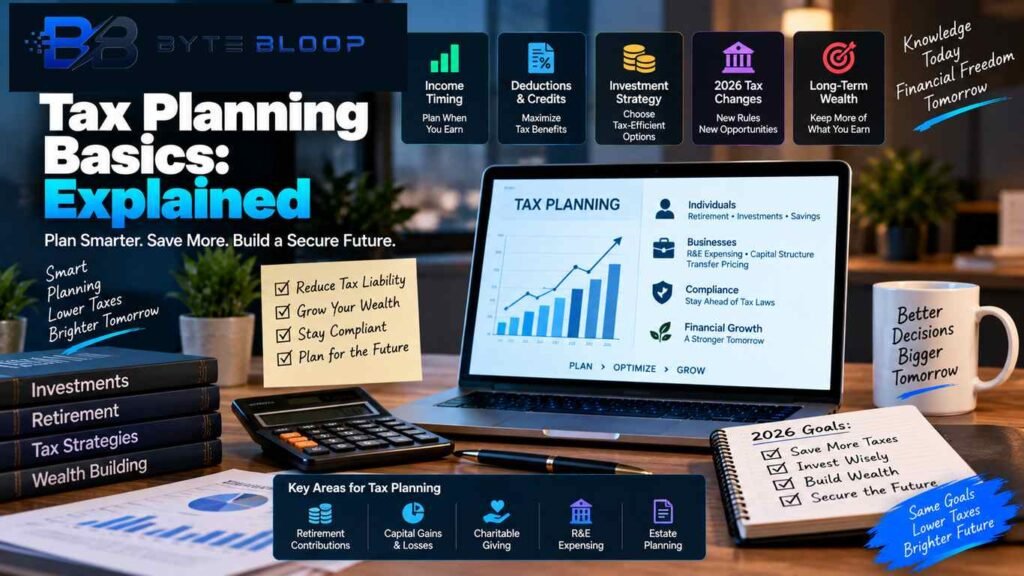
Tax Planning Basics Explained: 10 Smart Strategies, Deductions & Rules in 2026
Introduction
Tax planning basics explained in simple terms, tax planning is the process of organizing your income, expenses, investments, deductions, and other financial decisions so that you can meet your tax obligations efficiently while following the law.
Tax planning is different from tax evasion. The goal of legitimate tax planning is to understand the rules that apply to you and arrange financial decisions accordingly.
The exact strategies depend on the country, tax year, income type, filing status, investment structure, and whether you are an individual or a business. A strategy that works in the United States may not apply in India, and a tax rule that applies in one financial year can change in a later year.
For example, the U.S. Internal Revenue Service lists a $24,500 employee elective-deferral limit for many 401(k)-type retirement plans for 2026 and a $7,500 IRA contribution limit. In India, the Income Tax Department publishes separate rules for the old and new tax regimes for AY 2026–27.
That is why good tax planning starts with understanding which tax system applies to you.
This guide explains the fundamentals of tax planning, common strategies, deductions and credits, investment considerations, retirement planning, business tax planning, international considerations, mistakes to avoid, and how to review your plan during 2026.
Disclaimer: This article provides general educational information and is not legal, financial, investment, or tax advice. Tax rules can change, and the correct treatment depends on your individual circumstances and jurisdiction.
What Is Tax Planning?
Tax planning is the structured process of reviewing your finances and making lawful decisions that affect your current or future tax liability.
It can involve:
- Income timing
- Deductions
- Tax credits
- Retirement contributions
- Investment decisions
- Business expenses
- Capital gains and losses
- Charitable contributions
- Estate planning
- International tax considerations
A tax-planning decision should not be based only on reducing the current tax bill.
You also need to consider:
- Cash flow
- Investment goals
- Risk
- Future income
- Liquidity
- Compliance
- Long-term financial objectives
The lowest immediate tax liability is not automatically the best financial outcome.
Tax Planning vs Tax Preparation
These two activities are related but different.
Tax Planning
Tax planning happens before or during the financial year.
Examples include:
- Deciding how much to contribute to a retirement account
- Considering when to sell an investment
- Reviewing business expenses
- Selecting between available tax structures
- Estimating year-end tax liability
Tax Preparation
Tax preparation happens when you calculate and file the tax return.
It involves:
- Gathering records
- Reporting income
- Claiming eligible deductions
- Calculating taxes
- Filing required forms
Good tax planning can make tax preparation easier because you have already maintained records and reviewed relevant decisions.
Why Tax Planning Matters
Taxes can affect your:
- Take-home income
- Investment returns
- Business profitability
- Retirement savings
- Cash flow
- Estate plans
A small difference in tax treatment can matter over a long period, especially when investments or business income compound over several years.
However, tax planning should always remain connected to the underlying financial decision.
For example, selling an investment purely to create a tax result can make little sense if the investment itself is still suitable for your objectives.
The Main Pillars of Tax Planning
Tax planning can be organized around several broad areas.
Income Timing
Income timing means considering when taxable income is recognized.
Depending on the tax system and your circumstances, accelerating or delaying certain income may affect the tax rate or deductions available in a particular year.
The rules can be highly specific, so timing strategies should be checked against the applicable tax law.
Deductions
Deductions can reduce the income amount subject to tax, where the relevant law allows them.
Examples may include:
- Eligible business expenses
- Retirement contributions
- Certain interest expenses
- Qualifying charitable contributions
Eligibility depends on the tax jurisdiction and taxpayer circumstances.
Tax Credits
A tax credit generally reduces tax directly rather than reducing taxable income.
The structure and availability of credits vary widely.
Investment Structure
The tax treatment of an investment can depend on:
- Type of asset
- Holding period
- Account structure
- Income produced
- Country
- Taxpayer status
This is why two investments with similar pre-tax returns can produce different after-tax results.
Retirement Planning
Retirement accounts can provide tax advantages depending on the jurisdiction.
In the United States, for example, IRS 2026 limits include a $24,500 basic elective-deferral limit for many 401(k)-type plans and $7,500 for IRAs.
In other countries, retirement and pension systems follow different rules.
Tax Planning for Individuals
Individuals often focus on five areas:
- Income
- Deductions
- Investments
- Retirement
- Major financial transactions
Review Your Total Income
Start by identifying all taxable income sources.
These might include:
- Salary
- Freelance income
- Business income
- Interest
- Dividends
- Rental income
- Capital gains
- Other taxable receipts
Knowing the full picture is necessary before evaluating deductions or tax-saving strategies.
Review Your Deductions
Create a list of deductions you may qualify for.
Do not claim an expense simply because it sounds tax-related.
Check:
- Eligibility
- Documentation
- Limits
- Deadlines
- Filing requirements
Review Your Investment Gains and Losses
Investment transactions can create taxable gains or deductible losses depending on local law.
Tax-loss harvesting is a U.S. strategy involving the realization of losses to offset eligible gains under applicable rules, but similar concepts do not necessarily work in the same way in every country.
Always check the jurisdiction-specific rules before implementing such a strategy.
Plan Large Transactions
Major financial events can affect taxes.
Examples include:
- Selling property
- Selling securities
- Starting a business
- Receiving a bonus
- Exercising certain options
- Retiring
- Receiving an inheritance
A tax review before a major transaction can help you understand the consequences.
Tax Planning in India
Tax planning in India depends on the financial year, assessment year, taxpayer type, source of income, and tax regime.
The Income Tax Department states that for AY 2026–27, the new tax regime is the default regime for eligible individuals and certain other taxpayers, while eligible taxpayers can opt for the old regime subject to the applicable rules.
The Income Tax Department also provides an official Income and Tax Estimator that can compare tax under the old and new regimes based on the information entered by the taxpayer.
Old vs New Tax Regime
When applicable, taxpayers should compare:
- Taxable income
- Available deductions
- Exemptions
- Applicable rates
- Rebate eligibility
- Overall tax liability
A taxpayer who qualifies for significant deductions may have a different outcome from someone whose income structure has fewer eligible deductions.
There is therefore no universal answer about which regime produces the lower tax bill for every taxpayer.
Use the Official Tax Calculator
For current India tax calculations, the government’s e-filing portal provides an Income and Tax Estimator.
Use the official tool with your actual income and eligible deductions rather than relying on generic examples from blogs or social media.
Tax Planning in the United States
U.S. taxpayers have several tax-planning areas that differ from many other countries.
Retirement Contributions
For 2026, the IRS lists:
- 401(k) basic elective-deferral limit: $24,500
- IRA contribution limit: $7,500
- Higher catch-up contribution provisions for eligible older taxpayers
These are U.S.-specific rules and should not be applied to Indian taxpayers.
Capital Gains
U.S. tax treatment can depend on the type and timing of the gain and the taxpayer’s circumstances.
Investors should consider the tax consequence before selling assets rather than looking only at the investment return.
Charitable Contributions
Charitable giving can have tax implications depending on the donor, type of donation, receiving organization, and applicable rules.
Detailed documentation is important.
Tax Planning for Investments
Investors should compare investments using both pre-tax and after-tax outcomes.
Taxable Investments
Income can arise from:
- Interest
- Dividends
- Capital gains
- Rental income
The tax treatment varies.
Tax-Advantaged Accounts
Some jurisdictions offer accounts or structures designed to provide specific tax benefits.
Examples include retirement or pension arrangements.
Asset Location
Where an investment is held can affect how its income is taxed.
For example, the same asset may have different tax consequences when held in a taxable account versus an eligible tax-advantaged account.
Rebalancing
Rebalancing a portfolio can create taxable events when assets are sold.
Investors should consider both portfolio risk and tax consequences before making large changes.
Tax-Loss Harvesting Explained
Tax-loss harvesting involves realizing an eligible investment loss and using it according to the applicable tax rules.
The exact implementation depends heavily on jurisdiction.
A simplified example:
Suppose an investor buys an asset for 100 and later sells it for 80.
The investor has realized a loss of 20.
Whether that loss can offset other gains, other types of income, or future taxable amounts depends on local legislation.
Rules can also restrict repurchases or otherwise change the tax treatment.
Therefore, tax-loss harvesting should never be treated as a universal strategy.
Tax Planning for Retirement
Retirement planning and tax planning often overlap.
Start Early
Earlier contributions can provide more time for savings and investment growth.
Review Contribution Limits
Contribution limits can change between tax years.
In the United States, for example, the IRS publishes annual limits and cost-of-living adjustments.
Consider Withdrawal Rules
The tax benefit of contributing to a retirement account may be linked to how withdrawals are taxed later.
Coordinate Multiple Accounts
Taxable, tax-deferred, and tax-free structures can have different implications.
A retirement plan should therefore consider both contributions and future withdrawals.
Tax Planning for Small Businesses
Business tax planning involves more than simply collecting receipts.
Track Business Expenses
Maintain documentation for legitimate business expenses.
Separate Business and Personal Finances
Using separate accounts can simplify accounting and record keeping.
Review Business Structure
The appropriate legal and tax structure depends on the jurisdiction and business circumstances.
Review Payroll and Contractor Payments
Employment taxes, payroll obligations, and contractor reporting rules can apply differently depending on the country.
Keep Accurate Records
Accurate accounting records are central to tax compliance.
For a related guide, see:
Research and Development Tax Planning
Some jurisdictions offer tax incentives related to research and development.
However, rules vary significantly by country and year.
Do not assume that every software-development or innovation expense automatically qualifies.
Businesses should confirm:
- Eligible activities
- Eligible costs
- Documentation requirements
- Filing procedures
- Claim limits
- Applicable tax year
Business Capital Structure
Businesses may also review how financing affects taxes.
Possible sources include:
- Equity
- Debt
- Retained earnings
- External investment
Interest deductions, withholding taxes, capital gains, and other rules can affect the after-tax result.
The correct approach depends on the business structure and jurisdiction.
International Tax and Transfer Pricing
Multinational businesses may need to consider transfer pricing when transactions occur between related entities in different jurisdictions.
The OECD Transfer Pricing Guidelines provide an international framework based on the arm’s-length principle for pricing cross-border transactions between associated enterprises.
Transfer-pricing planning may involve:
- Related-party services
- Intellectual property
- Financing
- Distribution
- Manufacturing
- Intercompany agreements
OECD work on transfer pricing continued in 2026, including consultation on proposed revisions to Chapter VII concerning intra-group services.
Businesses with cross-border transactions should use qualified tax professionals for jurisdiction-specific analysis.
Tax Planning for Charitable Giving
Charitable donations can have tax consequences depending on local rules.
Before making a large donation, verify:
- Whether the recipient is eligible
- Whether the donation is deductible
- Documentation requirements
- Deduction limits
- Applicable valuation rules
The tax benefit should not be the only reason for a charitable decision.
Estate and Inheritance Planning
Estate planning can overlap with taxation.
Possible considerations include:
- Property transfers
- Gifts
- Inheritance
- Trust structures
- Beneficiary arrangements
- Business succession
Estate and inheritance rules are highly jurisdiction-specific.
A strategy that works in the U.S. may be completely different in India or another country.
Tax Planning and Cash Flow
Tax efficiency and cash-flow management should be considered together.
A strategy may reduce current tax but still create a cash-flow problem.
For example, a business might receive a deduction only after making a payment.
A good tax plan therefore asks:
How much tax is saved?
and also:
When does the cash leave the business or individual?
Common Tax Planning Mistakes
Waiting Until Filing Season
Many tax decisions become difficult to change after the tax year has ended.
Chasing Every Deduction
Not every deduction is worth pursuing if the cost, complexity, or risk outweighs the benefit.
Mixing Tax Systems
Rules from one country should not be copied into another country’s tax return.
Ignoring Documentation
A tax position without supporting records can create compliance problems.
Forgetting Future Taxes
Some strategies defer taxes rather than permanently eliminating them.
Ignoring Rule Changes
Tax rules can change between tax years.
Relying on Social Media
Tax posts often omit conditions, limits, exceptions, and jurisdiction.
A Simple Tax Planning Process
A practical review can follow these steps.
Step 1: Identify Your Jurisdiction
Determine the country and relevant tax year.
Step 2: List Income Sources
Include salary, business income, investments, rental income, and other taxable sources.
Step 3: List Potential Deductions and Credits
Check which ones you actually qualify for.
Step 4: Review Investments
Look at gains, losses, dividends, interest, and account structures.
Step 5: Review Major Transactions
Consider upcoming sales, purchases, bonuses, retirement, or business changes.
Step 6: Estimate Tax
Use an official tax calculator where available.
For India, the Income Tax Department provides an official Income and Tax Estimator that can compare applicable tax-regime outcomes.
Step 7: Check Documentation
Keep invoices, statements, receipts, contribution records, and other required documents.
Step 8: Review Before Filing
Compare your records with the tax return before submission.
How Often Should You Review Tax Planning?
Tax planning should not be a once-a-year activity.
A useful schedule is:
Beginning of the Year
Set income and savings assumptions.
Mid-Year
Check whether income and deductions are tracking differently from expectations.
Before Major Transactions
Review potential tax consequences.
Year-End
Estimate your final tax position and identify actions that must legally occur before year-end.
Filing Season
Confirm records and compare the final return with previous estimates.
Tax Planning Software and Tools
Technology can make tax planning and record keeping easier.
Useful categories include:
- Tax calculators
- Accounting software
- Expense trackers
- Investment reporting tools
- Payroll software
- Document-management systems
However, software should support—not replace—understanding of the applicable rules.
For India, the government’s e-filing portal provides its own Income and Tax Estimator.
For business bookkeeping, see:
Tax Planning in 2026
Tax planning in 2026 requires extra attention because tax systems are continuing to change.
In the United States, the IRS has published the 2026 retirement-account contribution limits and related cost-of-living adjustments.
In India, the Income Tax Department provides AY 2026–27 guidance covering the new and old tax regimes and an official calculator for estimating tax under the applicable rules.
For multinational businesses, OECD transfer-pricing work also continued during 2026, including work concerning intra-group services.
The practical lesson is simple:
Do not use a generic “2026 tax strategy” without checking the country, taxpayer type, tax year, and actual rules that apply.
Tax Planning for High-Income Individuals
Higher-income taxpayers may face more complex tax issues.
Potential areas include:
- Multiple income sources
- Investments
- Business ownership
- Property
- Charitable giving
- Retirement structures
- Estate planning
- International assets
Complexity often makes professional advice more valuable because several tax rules can interact.
Tax Planning for Freelancers
Freelancers should pay particular attention to:
- Income records
- Business expenses
- Advance tax or estimated taxes where applicable
- Invoicing
- Retirement savings
- Health or insurance deductions where relevant
- Professional documentation
Keeping business and personal transactions organized throughout the year can simplify tax preparation.
Tax Planning for Investors
Investors should consider:
- Purchase price
- Sale price
- Holding period
- Dividends
- Interest
- Account type
- Tax jurisdiction
- Losses
- Future transactions
Portfolio decisions should therefore consider after-tax returns, not only headline performance.
Tax Planning for Digital Businesses
Online businesses may receive income from several countries.
Potential issues include:
- Sales taxes or GST/VAT
- Income tax
- Withholding
- Platform fees
- Cross-border payments
- Contractor payments
- Transfer pricing
- Digital services rules
Businesses selling internationally should determine which country or jurisdiction has taxing rights before assuming that one country’s rules apply everywhere.
Tax Planning and Compliance
Tax planning should always operate within the law.
A compliant tax plan should:
- Use accurate records
- Apply legitimate deductions
- Report required income
- Follow filing deadlines
- Maintain supporting documentation
- Respect applicable anti-avoidance rules
The distinction between legal tax planning and unlawful tax evasion is fundamental.
Key Takeaways
- Tax planning basics explained means organizing financial decisions to manage taxes legally and efficiently.
- Tax rules vary by country, taxpayer, income type, and tax year.
- Income timing, deductions, credits, investments, and retirement planning are common tax-planning areas.
- U.S. taxpayers have 2026 retirement contribution limits published by the IRS, including a $24,500 401(k) elective-deferral limit and $7,500 IRA contribution limit.
- India’s AY 2026–27 rules include a default new tax regime for eligible taxpayers, with an option to choose the old regime subject to the applicable conditions.
- The Indian Income Tax Department provides an official tax estimator for comparing applicable regime outcomes.
- Investment tax strategies such as tax-loss harvesting are jurisdiction-specific.
- Businesses should track expenses, records, payroll, and corporate structure carefully.
- International businesses may need transfer-pricing analysis based on the OECD arm’s-length framework.
- Tax deferral is not always the same as permanent tax savings.
- Documentation is an important part of tax compliance.
- Tax planning should be reviewed throughout the year rather than only during filing season.
- Professional advice can be especially important for complex, high-value, cross-border, or business situations.
Frequently Asked Questions
What is tax planning?
Tax planning is the process of organizing income, expenses, investments, deductions, and other financial decisions to manage taxes legally and efficiently.
Is tax planning legal?
Yes. Legitimate tax planning involves following applicable laws while making lawful financial decisions. Tax evasion is different and is unlawful.
When should I start tax planning?
Tax planning is most useful before and during the tax year because many financial decisions become difficult or impossible to change after year-end.
What are the main parts of tax planning?
Common areas include income timing, deductions, credits, investments, retirement planning, business expenses, charitable giving, and estate planning.
What is the difference between a deduction and a tax credit?
A deduction generally reduces taxable income, while a tax credit generally reduces the tax itself. The exact treatment depends on local law.
What is tax-loss harvesting?
Tax-loss harvesting generally means realizing an eligible investment loss and using it under applicable tax rules to offset gains or otherwise affect taxable income. The rules differ significantly by jurisdiction.
Is tax-loss harvesting available everywhere?
No. Tax-loss rules vary by country and sometimes by asset type, account type, and taxpayer status.
What is tax-efficient investing?
Tax-efficient investing means considering how investment income and gains will be taxed when selecting assets, accounts, and transaction timing.
What is the U.S. 401(k) contribution limit for 2026?
The IRS states that the basic elective-deferral limit for many 401(k)-type plans is $24,500 for 2026.
What is the U.S. IRA contribution limit for 2026?
The IRS states that the annual IRA contribution limit for 2026 is $7,500, subject to the applicable rules and limits.
What is the new tax regime in India?
The new tax regime is the default regime for eligible taxpayers for the relevant assessment year, while eligible taxpayers may opt for the old regime subject to the applicable rules.
Can I compare India’s old and new tax regimes?
Yes. The Income Tax Department provides an official Income and Tax Estimator that can compare tax under the applicable old and new regimes.
Should I choose the old or new tax regime in India?
The outcome depends on your income, deductions, exemptions, and other circumstances. There is no single regime that produces the same result for every taxpayer. The official tax estimator can help with the comparison.
Are retirement contributions tax-deductible?
They can be in some tax systems and under specific conditions. The treatment depends on the account type, taxpayer, and jurisdiction.
Can businesses use tax planning?
Yes. Businesses can review expenses, financing, investment, depreciation or other capital allowances, research incentives, payroll, business structure, and international transactions.
What is transfer pricing?
Transfer pricing concerns the pricing of transactions between related entities, particularly across borders. OECD guidance uses the arm’s-length principle as a central framework.
Why is documentation important for taxes?
Records help support reported income, expenses, deductions, credits, and other tax positions if they are later reviewed.
Can tax planning reduce taxes permanently?
Sometimes a legitimate strategy can reduce tax, while other strategies merely defer when tax is paid. The difference depends on the tax rule and financial structure.
Should I sell an investment just to save taxes?
Tax should be one consideration, not the only one. Selling an otherwise suitable investment can create financial consequences that outweigh a tax benefit.
How often should I review tax planning?
A useful approach is to review your plan at the beginning of the year, during the year, before major transactions, and before filing.
Can accounting software help with tax planning?
Accounting software can help organize income, expenses, invoices, and records, but it does not replace tax-law analysis.
For related information, read:
Can tax rules change during the year?
Yes. Tax laws, regulations, administrative guidance, thresholds, and official interpretations can change. Always verify important current rules with the relevant tax authority.
What is tax planning for freelancers?
It involves organizing freelance income, allowable expenses, records, estimated or advance taxes where applicable, and other obligations relevant to self-employed taxpayers.
What is tax planning for investors?
It involves considering the tax treatment of investment income, capital gains, losses, account structures, and transaction timing.
What is tax planning for businesses?
It involves reviewing the tax effects of business income, expenses, financing, investment, payroll, incentives, corporate structure, and other commercial decisions.
What is international tax planning?
International tax planning examines how income, assets, transactions, and business activities are taxed across multiple jurisdictions while complying with applicable laws.
Do I need a tax professional?
Simple tax situations may be manageable using official guidance and tax software, while complex business, investment, estate, or cross-border situations may benefit from qualified professional advice.
Conclusion
Tax planning basics explained simply is the process of making informed financial decisions with taxes in mind while remaining compliant with the applicable law.
The core principles are straightforward: understand your tax jurisdiction, identify your income, review eligible deductions and credits, consider investment and retirement structures, maintain accurate records, and review major financial decisions before acting.
The details, however, are highly jurisdiction-specific.
For example, U.S. taxpayers have IRS-published 2026 retirement contribution limits, including $24,500 for many 401(k)-type elective deferrals and $7,500 for IRAs. India has a different tax framework, and the Income Tax Department provides AY 2026–27 regime guidance and an official calculator. Businesses operating across borders may also need to consider transfer pricing and the OECD arm’s-length framework.
The most practical approach is to avoid generic “tax hacks” and instead build a plan around your actual income, financial goals, investments, business structure, and country-specific rules.
Tax planning is also an ongoing process. Reviewing your position during the year can help you spot important changes before they become difficult to address.
For complex situations—especially business, investment, inheritance, estate, or international tax matters—professional tax advice can help ensure that the strategy matches the law and your circumstances.
Related Reading
Sources & References
IRS — 401(k) Limit Increases to $24,500 for 2026
IRS — 2026 Retirement Contribution Limits
India Income Tax Department — Salaried Individuals AY 2026–27