Bluetooth 5 vs Bluetooth 6 Explained: 10 Important Differences in 2026
Introduction
Bluetooth 5 vs Bluetooth 6 is not simply a comparison of two speed numbers. Bluetooth 5 and Bluetooth 6 represent different generations of the Bluetooth Core Specification, with improvements introduced across several releases and feature areas.
Bluetooth Core 5.0 was adopted in 2016 and introduced features including the LE 2M PHY, LE Coded PHY for longer-range communication, advertising extensions, and an improved channel-selection algorithm. Bluetooth SIG described Core 5.0 as providing up to twice the LE data rate, up to four times the range under the relevant long-range mode, and eight times the advertising capacity compared with earlier Bluetooth LE capabilities.
Bluetooth Core 6.0 was adopted in August 2024 and introduced several new features, most notably Bluetooth Channel Sounding, which enables more precise distance measurement between Bluetooth devices. It also introduced Decision-Based Advertising Filtering, Monitoring Advertisers, improvements to the Isochronous Adaptation Layer, a larger Link Layer feature set, and negotiable frame spacing.
It is also important to remember that “Bluetooth 5” and “Bluetooth 6” do not describe every capability of a device by themselves. Features depend on the specific Bluetooth Core version, profiles, optional features, controller implementation, operating system, antenna design, and manufacturer implementation.
As of 2026, the Bluetooth SIG specifications page lists Core 6.3 as an adopted specification, so Bluetooth 6.x is an evolving family rather than a single frozen feature set.
This guide compares Bluetooth 5 and Bluetooth 6, explains the real differences, and shows what those changes mean for phones, earbuds, smart devices, trackers, gaming accessories, and IoT products.
What Is Bluetooth 5?
Bluetooth 5 is a family of Bluetooth Core Specification releases beginning with Bluetooth 5.0 in 2016.
Bluetooth 5.0 introduced important improvements for Bluetooth Low Energy, including:
- LE 2M PHY
- LE Coded PHY
- LE Long Range
- Advertising Extensions
- Improved channel selection
- Increased advertising capacity
The LE 2M PHY provides a 2 Mbps PHY data rate, while LE Coded PHY can prioritize range using forward-error-correction coding at lower bit rates.
Later releases in the Bluetooth 5.x family, such as 5.1, 5.2, 5.3 and 5.4, added additional features. For example, Bluetooth 5.1 introduced Direction Finding, while Bluetooth 5.2 introduced LE Isochronous Channels that enabled the technical foundation for LE Audio.
So when comparing Bluetooth 5 vs Bluetooth 6, it is more accurate to think about the capabilities of the specific 5.x and 6.x implementations rather than treating Bluetooth 5 as one exact feature set.
What Is Bluetooth 6?
Bluetooth 6 refers to the Bluetooth Core Specification 6.x generation.
Core 6.0 was officially adopted on August 27, 2024.
Its most notable new feature is Bluetooth Channel Sounding.
Bluetooth SIG describes Channel Sounding as a secure fine-ranging technology that allows compatible Bluetooth devices to calculate distance more accurately. Early implementations have demonstrated approximately ±20 cm accuracy under certain conditions, while the technology is designed for centimeter-level ranging.
Bluetooth 6.0 also introduced:
- Decision-Based Advertising Filtering
- Monitoring Advertisers
- ISOAL enhancements
- LL Extended Feature Set
- Frame Space Update
- Channel Sounding
Later Bluetooth 6.x releases continue to add and refine capabilities, which is why device specifications should be checked carefully rather than relying only on the “Bluetooth 6” label.
Bluetooth 5 vs Bluetooth 6: Key Differences
1. Distance and Positioning
One of the most important differences is positioning capability.
Bluetooth 5.0 introduced longer-range LE communication through the LE Coded PHY, and Bluetooth 5.1 later introduced Direction Finding. Direction Finding supports Angle of Arrival and Angle of Departure techniques for positioning applications.
Bluetooth 6.0 adds Channel Sounding, which is designed specifically for fine distance measurement.
Channel Sounding combines phase-based ranging and round-trip-time techniques to provide more accurate and secure distance awareness. Bluetooth SIG says early implementations have demonstrated measurements around ±20 cm in suitable conditions.
This makes Bluetooth 6 particularly relevant to applications such as:
- Digital keys
- Item tracking
- Location-aware devices
- Indoor positioning
- Proximity applications
2. Data Rate
A common misconception is that Bluetooth 6 automatically increases Bluetooth LE speed from 2 Mbps to 3 Mbps.
That is not how the specification works.
Bluetooth 5.0 introduced the LE 2M PHY, which provides a 2 Mbps PHY data rate.
Bluetooth Core 6.0 does not define a simple “3 Mbps Bluetooth LE” replacement for that.
Actual throughput depends on the radio mode, protocol overhead, packet configuration, implementation, and the specific Bluetooth technology being used.
Therefore:
Bluetooth 6 is not primarily a speed upgrade.
Its major value is in features such as ranging, advertising efficiency, reliability and protocol improvements.
3. Audio
Bluetooth audio is another area where version numbers can be misleading.
The Bluetooth LE Audio architecture was enabled by features introduced in Bluetooth Core 5.2, including LE Isochronous Channels. LE Audio uses the LC3 codec, which was defined as part of the LE Audio specifications.
Therefore, it is incorrect to say that Bluetooth 6 itself introduced LC3.
Similarly, LDAC is not a native Bluetooth 6 codec.
Audio codec support depends on the product, operating system, profile, and implementation.
A device advertised as Bluetooth 6 can still use different audio technologies depending on the manufacturer’s hardware and software.
4. Latency
Bluetooth 6 should not be described as guaranteeing “sub-1 ms latency.”
Bluetooth performance depends on the protocol being used, packet scheduling, application, controller, operating system, radio conditions, and device implementation.
Core 6.0 does include ISOAL improvements and a new frame-spacing capability. Bluetooth SIG says its ISOAL enhancements can reduce latency in applications sensitive to it, while Frame Space Update makes transmission spacing negotiable instead of maintaining the previous fixed 150 µs value.
So Bluetooth 6 can improve specific low-latency scenarios, but there is no universal “Bluetooth 6 = under 1 ms” rule.
5. Power Efficiency
Bluetooth Low Energy has been designed around low-power operation since its introduction.
Bluetooth 5.0 expanded long-range and high-speed LE capabilities while supporting low-power device designs. Later Bluetooth releases also introduced additional power and scheduling improvements.
Bluetooth 6 introduces several efficiency-related protocol improvements, but the specification does not mean that every Bluetooth 6 device automatically consumes 30% less power than Bluetooth 5.
Actual battery life depends on:
- Transmission power
- Connection interval
- Advertising frequency
- Data volume
- Chipset
- Antenna
- Software
- Application workload
So battery efficiency should be evaluated from the actual product specifications rather than the Bluetooth generation alone.
6. Advertising Efficiency
Bluetooth 6.0 introduced Decision-Based Advertising Filtering.
This allows a scanning device to make a decision based on information received on the primary advertising channels before deciding whether to continue scanning related packets on secondary channels.
The goal is to reduce unnecessary scanning work in certain scenarios.
Bluetooth 6.0 also introduced Monitoring Advertisers, which improves how devices can monitor whether specific advertisers remain present without continuously performing the same scanning process.
These changes are more technical than simply increasing speed, but they can be useful for connected devices that operate with large amounts of Bluetooth LE advertising traffic.
7. Security and Distance Verification
Bluetooth 5.x already includes mature security technologies.
Bluetooth 6.0’s Channel Sounding adds a new security dimension to distance measurement.
Its design combines phase-based ranging with round-trip-time measurements, providing a method that can help protect against certain relay and man-in-the-middle scenarios in distance-sensitive applications.
This is particularly relevant to applications such as digital car keys and secure proximity systems.
For a detailed explanation of Bluetooth security, read:
8. IoT and Smart Devices
Bluetooth 5.x is already widely used in:
- Sensors
- Wearables
- Smart-home devices
- Fitness trackers
- Beacons
- Industrial equipment
Bluetooth 5.0’s long-range PHY and advertising extensions made it useful for larger or more capable Bluetooth LE networks.
Bluetooth 6 adds capabilities that are particularly interesting for IoT devices requiring accurate distance awareness.
Examples include:
- Asset tracking
- Smart locks
- Digital keys
- Location-aware devices
- Warehouse tracking
- Proximity detection
Bluetooth SIG specifically cites digital keys and Find My-style networks as examples of applications for Channel Sounding.
9. Large-Scale Device Communication
Bluetooth LE continues to expand its ability to support large numbers of connected devices.
Bluetooth 5.0 increased advertising capacity, while later specifications introduced additional mechanisms for large-scale device communication.
For example, Periodic Advertising with Responses (PAwR) was introduced to support scenarios where a hub needs bidirectional communication with many endpoint devices. Bluetooth SIG identifies electronic shelf labels as one important application.
Bluetooth 6’s improvements to advertising filtering and advertiser monitoring build on this general direction toward more efficient device discovery and communication.
10. Future Device Capabilities
Bluetooth 5 remains relevant because its ecosystem is mature and widely deployed.
Bluetooth 6, meanwhile, enables capabilities that were difficult to implement with previous Bluetooth generations, particularly fine distance measurement.
This can open opportunities for:
- Smart access systems
- Vehicle digital keys
- Precision item finding
- Asset tracking
- Location-aware applications
- Advanced industrial IoT
The important point is that these benefits appear only when both the relevant devices and software support the required feature.
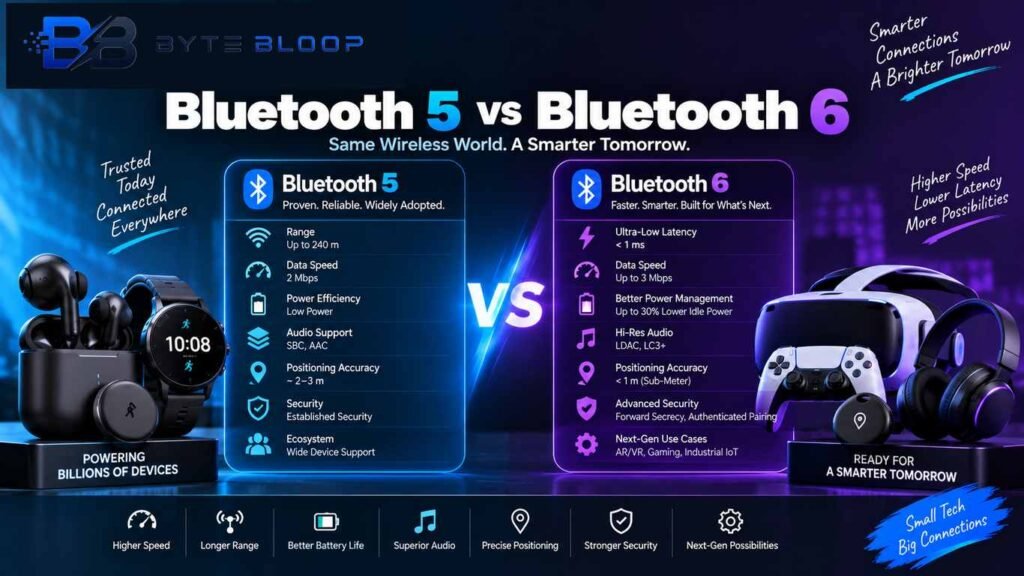
Bluetooth 5 vs Bluetooth 6: Comparison Table
| Feature | Bluetooth 5.x | Bluetooth 6.x |
|---|---|---|
| LE 2M PHY | Supported from 5.0 | Supported |
| LE Long Range | Introduced with 5.0 | Supported |
| Direction Finding | Added in 5.1 | Supported |
| LE Audio foundation | Introduced with 5.2 | Supported |
| LC3 | Part of LE Audio | Supported where LE Audio is implemented |
| Channel Sounding | Not available | Introduced in 6.0 |
| Fine distance measurement | More limited approaches | Major new capability with Channel Sounding |
| Advertising improvements | Introduced across 5.x | Further improvements in 6.0 |
| Frame Space Update | No | Introduced in 6.0 |
| Monitoring Advertisers | No 6.0 feature | Introduced in 6.0 |
| Device compatibility | Very broad | Increasing, but feature support varies |
The table describes specification-level capabilities; actual product support depends on the implementation.
Bluetooth 5 vs Bluetooth 6 for Smartphones
For smartphone users, the Bluetooth version number alone does not tell you exactly what features you will receive.
A phone may support Bluetooth 6 while a connected accessory supports only part of the available feature set.
For example, advanced Channel Sounding functionality requires compatible hardware and software on the relevant devices.
Before buying a phone or accessory, check the manufacturer’s specification for:
- Bluetooth Core version
- LE Audio
- Supported codecs
- Bluetooth profiles
- Channel Sounding
- Operating-system support
This is more useful than choosing a product based only on the generation number.
Bluetooth 5 vs Bluetooth 6 for Earbuds and Headphones
For wireless audio, Bluetooth version should not be treated as a direct measurement of sound quality.
Important factors include:
- Codec support
- Audio profile
- LE Audio support
- LC3 support
- Bluetooth Classic support
- Device compatibility
- Firmware
- RF performance
LE Audio is based on Bluetooth LE features introduced with Core 5.2 and uses LC3.
Therefore, a Bluetooth 5.2 or later headset may support features that are highly relevant to modern audio, even though its specification number is lower than Bluetooth 6.
Bluetooth 5 vs Bluetooth 6 for Gaming
Gaming requirements are often focused on latency and reliability.
Bluetooth 6 introduces technical improvements that can benefit certain latency-sensitive workflows, particularly through ISOAL and frame-spacing improvements.
However, this does not guarantee identical latency across every Bluetooth 6 controller or headset.
For gaming, also consider:
- Codec
- Audio pipeline
- Controller firmware
- Operating-system processing
- Wireless interference
- Device compatibility
- Manufacturer implementation
A product’s measured performance matters more than the Bluetooth generation label alone.
Bluetooth 5 vs Bluetooth 6 for Smart Home Devices
Bluetooth 5 remains useful for smart-home products such as sensors, switches, beacons, and low-power accessories.
Bluetooth 6 becomes particularly interesting when a smart-home application needs accurate distance awareness.
Examples include:
- Smart locks
- Digital keys
- Indoor location
- Item tracking
- Presence detection
Channel Sounding is one of the main reasons Bluetooth 6 can be attractive for these applications.
Bluetooth 5 vs Bluetooth 6 for Developers
Developers should not select a Bluetooth generation solely because it has a higher number.
Instead, identify the required feature first.
Need Longer LE Range?
Bluetooth 5.0’s LE Coded PHY can provide long-range operation with lower data rates.
Need Direction Finding?
Bluetooth 5.1 introduced Direction Finding capabilities.
Need LE Audio?
Bluetooth 5.2 introduced the LE Isochronous Channels foundation used by LE Audio.
Need Fine Distance Measurement?
Bluetooth 6.0’s Channel Sounding is the major relevant feature.
This feature-based approach is more useful than assuming every Bluetooth 6 device is automatically faster or better for every application.
Bluetooth 6 Features Explained
Channel Sounding
Channel Sounding measures distance using radio-signal characteristics between compatible Bluetooth devices.
Bluetooth SIG explains that it combines Phase-Based Ranging with Round-Trip Time techniques for accuracy and additional protection against relay attacks.
Decision-Based Advertising Filtering
This feature helps scanners avoid unnecessarily following every extended-advertising packet chain.
It can improve efficiency in situations with large amounts of advertising traffic.
Monitoring Advertisers
Monitoring Advertisers helps a device track the presence or absence of specific advertisers without repeatedly performing the same scanning operation.
This can be useful in proximity and connected-device applications.
ISOAL Improvements
Bluetooth 6.0 improves the Isochronous Adaptation Layer.
Bluetooth SIG notes that the changes can improve reliability and reduce latency for some isochronous applications.
Frame Space Update
Earlier Bluetooth configurations used a fixed frame-spacing value.
Bluetooth 6.0 makes frame spacing negotiable, allowing it to be shorter or longer depending on the connection requirements.
Is Bluetooth 6 Faster Than Bluetooth 5?
Not necessarily in the simple way many product descriptions suggest.
Bluetooth 5.0 introduced the LE 2M PHY with a 2 Mbps PHY rate. Bluetooth 6.0 does not replace this with a universal 3 Mbps LE mode.
Instead, Bluetooth 6’s most important advances are related to capabilities such as:
- Distance awareness
- Advertising efficiency
- Link-layer feature management
- Isochronous communication improvements
- Frame-spacing flexibility
So the headline improvement is new functionality and efficiency, not simply raw throughput.
Does Bluetooth 6 Improve Range?
Bluetooth 6 does not automatically mean dramatically more range than Bluetooth 5.
Bluetooth 5.0 introduced LE Coded PHY specifically for long-range communication, and the achievable range depends heavily on radio conditions, antenna design, transmit power, receiver sensitivity and implementation.
Bluetooth 6’s Channel Sounding has its own ranging characteristics and is not simply a replacement for LE Long Range.
Therefore, range and ranging accuracy should be treated as two separate specifications.
Does Bluetooth 6 Improve Audio Quality?
Bluetooth 6 itself does not guarantee higher audio quality.
Audio quality depends on the codec, bitrate, profile, hardware, software and implementation.
LE Audio and LC3 come from the Bluetooth LE Audio architecture introduced around Core 5.2 and completed as a specification set in 2022.
Therefore, when buying headphones, look at the actual codec and audio features instead of relying only on “Bluetooth 6.”
Bluetooth 5 vs Bluetooth 6 Compatibility
Bluetooth is designed for interoperability across generations, but this does not mean every device supports every feature.
A newer Bluetooth 6 phone can generally connect with many Bluetooth 5 accessories, but a feature introduced in Bluetooth 6 can only be used when the necessary hardware and software exist on both sides.
For example:
Bluetooth 6 phone + older Bluetooth 5 accessory
may still connect normally, but advanced Bluetooth 6-specific features may not be available.
This is why product specifications should identify feature support rather than simply listing a Bluetooth version.
Which Bluetooth Version Should You Choose?
The right choice depends on the application.
For Basic Wireless Accessories
Bluetooth 5.x can remain suitable for keyboards, mice, simple sensors, wearables and many other accessories.
For Long-Range BLE
Look for support for the LE Coded PHY and confirm the expected operating range for the actual product.
For Modern Audio
Look for LE Audio and codec support rather than assuming Bluetooth 6 automatically means better sound.
For Tracking and Digital Keys
Bluetooth 6’s Channel Sounding can be especially relevant where accurate distance measurement matters.
For Developers
Choose the version and optional features based on the exact technical requirements of your application.
Key Takeaways
- Bluetooth 5 and Bluetooth 6 are generations of the Bluetooth Core Specification.
- Bluetooth 5.0 introduced LE 2M PHY, LE Coded PHY and other major LE improvements.
- Bluetooth 6.0 was adopted in 2024 and introduced Channel Sounding plus several protocol enhancements.
- Bluetooth 6 does not mean a universal 3 Mbps LE data rate.
- Bluetooth 6 does not automatically guarantee sub-1 ms latency.
- LDAC is not a native Bluetooth 6 codec.
- LC3 belongs to the LE Audio architecture introduced with Bluetooth 5.2-era technologies.
- Channel Sounding is one of the biggest functional differences introduced with Bluetooth 6.0.
- Bluetooth 5.1 introduced Direction Finding, so advanced positioning is not entirely new to Bluetooth 6.
- Real-world performance depends on the complete device implementation, not only the Bluetooth version.
- Current Bluetooth 6.x specifications continue to evolve, so buyers and developers should check the specific feature set supported by a device.
Frequently Asked Questions
What is the main difference between Bluetooth 5 and Bluetooth 6?
The biggest new capability in Bluetooth 6.0 is Channel Sounding, which enables more accurate distance measurement between compatible Bluetooth devices. Bluetooth 6.0 also introduced several advertising, isochronous and link-layer improvements.
Is Bluetooth 6 faster than Bluetooth 5?
Not as a simple universal rule. Bluetooth 5.0 introduced a 2 Mbps LE PHY, while Bluetooth 6.0’s major changes focus more on new capabilities and efficiency than on introducing a universal higher LE speed.
Does Bluetooth 6 have 3 Mbps speed?
There is no universal Bluetooth 6 LE speed of 3 Mbps defined as the replacement for Bluetooth 5’s LE 2M PHY.
Does Bluetooth 6 have lower latency?
Bluetooth 6.0 includes ISOAL and frame-spacing improvements that can help certain latency-sensitive applications, but it does not guarantee a fixed latency such as 1 ms across all devices.
Does Bluetooth 6 support LC3?
Compatible Bluetooth 6 devices can support LE Audio and LC3, but LC3 is not a feature that was first introduced by Bluetooth 6. LE Audio is based on technologies introduced with Core 5.2.
Is LDAC a Bluetooth 6 codec?
No. LDAC is not a native Bluetooth Core 6 codec.
Does Bluetooth 6 have better range?
Not automatically. Bluetooth 5.0 introduced LE Coded PHY for long-range operation, while Bluetooth 6 introduces different capabilities such as Channel Sounding.
What is Bluetooth Channel Sounding?
Channel Sounding is a Bluetooth LE feature introduced in Core 6.0 that enables fine-ranging between compatible devices using radio-signal measurements.
How accurate is Bluetooth Channel Sounding?
Bluetooth SIG describes Channel Sounding as a centimeter-level ranging technology and reports early implementations achieving approximately ±20 cm accuracy under suitable conditions.
Is Bluetooth Channel Sounding the same as GPS?
No. Channel Sounding measures relative distance between compatible Bluetooth devices. It does not provide global positioning like GPS.
What is Direction Finding?
Direction Finding was introduced in Bluetooth Core 5.1 and supports Angle of Arrival and Angle of Departure techniques for Bluetooth positioning applications.
Will a Bluetooth 6 phone work with Bluetooth 5 earbuds?
Usually, Bluetooth devices are designed for interoperability, but the exact available features depend on the two devices. A newer phone does not automatically add newer features to older earbuds.
Should I buy Bluetooth 6 headphones?
Look at the actual features you need, such as codecs, LE Audio support, device compatibility and measured latency, rather than choosing based only on the Bluetooth generation number.
Is Bluetooth 5 still useful in 2026?
Yes. Bluetooth 5.x remains widely relevant for many low-power and general wireless applications, and later 5.x releases added capabilities beyond the original Bluetooth 5.0 specification.
Is Bluetooth 6 better for tracking devices?
Bluetooth 6 can be particularly useful for tracking applications that benefit from fine distance measurement because of Channel Sounding.
Does Bluetooth 6 reduce battery consumption by 30%?
There is no universal 30% battery-saving guarantee for Bluetooth 6 devices. Battery life depends on the device implementation and workload.
Does Bluetooth 6 provide sub-meter positioning?
Channel Sounding is designed for much finer ranging than traditional RSSI-based distance estimation, but real-world accuracy depends on implementation and environment. Bluetooth SIG reports early results around ±20 cm under suitable conditions.
Which Bluetooth version introduced LE Audio?
LE Audio depends on features introduced in Bluetooth Core 5.2, especially LE Isochronous Channels.
Which Bluetooth version introduced Direction Finding?
Bluetooth Core 5.1 introduced Bluetooth Direction Finding.
Which Bluetooth version introduced Channel Sounding?
Bluetooth Core 6.0 introduced Channel Sounding.
What is Decision-Based Advertising Filtering?
It is a Bluetooth 6.0 feature that allows a scanner to use information from primary advertising channels to decide whether it needs to scan related packets on secondary channels.
What is Monitoring Advertisers?
It is a Bluetooth 6.0 feature designed to make monitoring the presence of selected advertising devices more efficient.
Is Bluetooth 6 backward compatible?
Bluetooth devices are designed for interoperability, but advanced features generally require the relevant capability on the participating devices.
What should developers check before selecting Bluetooth 6?
Developers should evaluate required features, profiles, PHYs, operating range, positioning requirements, power consumption, security needs, operating-system support and chipset capabilities.
Is Bluetooth 6 the latest Bluetooth standard?
Bluetooth SIG’s current specifications page lists later 6.x specifications, including Core 6.3 as adopted in 2026. Therefore, “Bluetooth 6” represents a family of releases rather than one single final specification.
Conclusion
Bluetooth 5 vs Bluetooth 6 is best understood as a comparison of feature generations rather than a simple “old versus faster” upgrade.
Bluetooth 5.0 introduced major improvements to Bluetooth Low Energy, including the LE 2M PHY, LE Coded PHY, advertising extensions and improved radio capabilities. Later Bluetooth 5.x releases added Direction Finding and the foundation for LE Audio.
Bluetooth 6.0 introduced a different type of advancement. Its standout feature, Channel Sounding, brings much more precise distance awareness to Bluetooth LE and opens applications involving tracking, digital keys and proximity. Bluetooth 6.0 also adds improvements to advertising, isochronous data handling, link-layer feature exchange and frame spacing.
For consumers, this means a Bluetooth 6 label should not automatically be interpreted as better audio, dramatically greater range or universally lower latency. The actual features supported by the phone, headphones, controller, tracker or IoT device matter more than the version number alone.
For developers, the better approach is to start with the required feature—long range, LE Audio, direction finding, fine ranging or low-power communication—and then select hardware and software that support that feature properly.
As Bluetooth 6.x continues to evolve, the most useful specification is increasingly not just the Bluetooth version, but the exact capabilities implemented by the product.
Related Reading
3D Printing Explained: How It Works, Types, Uses and Benefits
ByteBloop Smartphones & Technology Guides
Sources & References
Bluetooth SIG — Core Specification 6.0
Bluetooth SIG — Core 6.0 Feature Overview
Bluetooth SIG — Channel Sounding
Bluetooth SIG — Core 5.0: What’s New