AI Robotics AI: Explained
Introduction
Artificial intelligence has long been the imagined mind behind autonomous machines, but the reality of AI‑driven robotics is now a tangible, rapidly evolving field. By blending mechanical engineering, computer science, and machine learning, AI robotics equips robots with perception, decision‑making, and adaptive control, enabling them to perform tasks from industrial assembly to surgical assistance. In 2026, the convergence of large language models (LLMs), reinforcement learning, and edge computing has lowered the barrier to entry, allowing startups and large enterprises alike to prototype sophisticated robotic systems. This guide unpacks the core principles that make AI robotics possible, highlights practical use cases, and examines the trade‑offs that developers and businesses face today.
At its heart, AI robotics is about giving a machine a “brain” that can interpret sensory data, learn from experience, and act autonomously. The IBM 2026 AI Guide notes that AI terminology now includes concepts such as Retrieval‑Augmented Generation (RAG) and AI slop, which are crucial for understanding how modern models process information. Meanwhile, robotics courses emphasize the integration of control theory with deep learning, ensuring that robots not only see but also move safely. Understanding these fundamentals is essential for anyone looking to build or deploy AI‑powered robots.
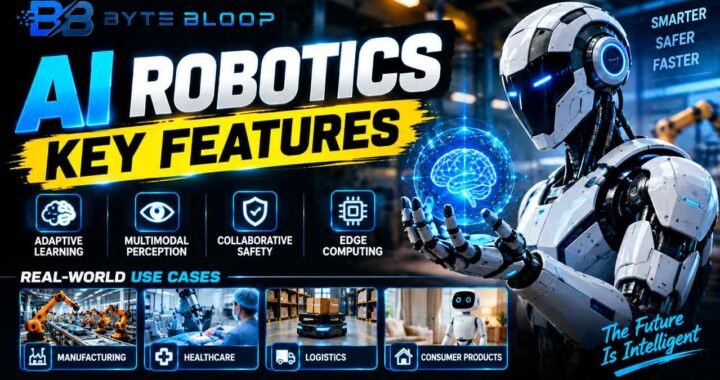
Key features of AI robotics include perception pipelines that fuse camera, lidar, and tactile data; decision layers that use reinforcement learning or symbolic planning; and real‑time control loops that translate high‑level intent into motor commands. Practical examples range from collaborative industrial arms that adjust grip force on the fly to autonomous delivery drones that navigate dynamic urban environments. However, the technology is not without challenges: latency, data privacy, and the need for robust safety validation remain significant hurdles.
In the following sections, we will explore the building blocks of AI robotics, illustrate real‑world applications, weigh the pros and cons, and offer actionable insights for practitioners and enthusiasts.
Core Building Blocks of AI Robotics
1. Perception – Sensors such as RGB cameras, depth sensors, and force‑tactile arrays feed raw data into neural networks that extract features like edges, textures, and object poses. Modern convolutional architectures and transformer‑based vision models enable real‑time object detection even in cluttered scenes.
2. Learning & Decision Making – Reinforcement learning (RL) allows robots to discover optimal policies through trial and error, while supervised learning trains perception modules on labeled datasets. Hybrid approaches combine symbolic planners with learned policies to balance safety and flexibility.
3. Control & Actuation – Low‑level controllers convert high‑level decisions into joint torques or motor currents. Model predictive control (MPC) and adaptive control schemes help maintain stability when the robot interacts with uncertain environments.
4. Edge & Cloud Integration – Edge inference reduces latency for time‑critical tasks, whereas cloud services provide heavy‑weight training and data aggregation. The 2026 AI Automation Guide highlights how hybrid architectures enable continuous learning while respecting data sovereignty.
Real‑World Use Cases
Industrial Automation – Collaborative robots (cobots) use vision‑guided grasping to handle delicate components, reducing downtime and increasing throughput. A leading automotive supplier reported a 15% yield improvement after integrating AI perception into its assembly line.
Healthcare – Surgical robots leverage RL‑based motion planning to perform minimally invasive procedures with sub‑millimeter precision. Hospitals are also deploying bedside robots that monitor vitals and deliver medication autonomously.
Agriculture – Autonomous tractors equipped with LIDAR and crop‑health imaging use reinforcement learning to optimize planting density and irrigation schedules, cutting water usage by up to 20%.
Service & Delivery – Delivery drones and sidewalk robots navigate pedestrian traffic by combining LIDAR mapping with LLM‑driven path planning, allowing them to adapt to unexpected obstacles in real time.
Pros and Cons
Pros
- Increased efficiency and precision in repetitive tasks.
- Enhanced safety through predictive motion planning.
- Scalability via cloud‑based learning and data sharing.
Cons
- High upfront cost for sensors, compute, and safety certification.
- Complexity in integrating heterogeneous hardware and software stacks.
- Ethical and privacy concerns around data collection and autonomous decision making.
Practical Tips for Getting Started
1. Start Small – Build a single‑arm prototype with off‑the‑shelf components (e.g., Raspberry Pi, Arduino, and a depth camera) to validate perception pipelines before scaling.
2. Leverage Open‑Source Frameworks – ROS 2, OpenAI Gym, and PyTorch Lightning provide mature ecosystems for simulation, training, and deployment.
3. Prioritize Safety – Implement hardware safety interlocks and software fail‑safe states; use formal verification where possible.
4. Iterate with Simulation – Use physics engines (e.g., Gazebo, MuJoCo) to test RL policies in a risk‑free environment, then transfer to hardware with domain randomization.
Future Outlook
By 2030, the integration of LLMs into robotic control loops is expected to enable robots that can interpret natural language instructions and adjust their behavior on the fly. Coupled with advances in neuromorphic chips, we may see a new generation of low‑power, highly responsive robots suitable for home and personal use.
Key Takeaways
- AI robotics blends perception, learning, and control to create autonomous machines.
- Industrial, healthcare, agriculture, and service sectors already reap efficiency gains from AI robots.
- Key challenges include high cost, system complexity, and ethical data concerns.
- Starting with small prototypes and open‑source tools lowers the entry barrier.
- Future LLM integration promises natural‑language‑driven robot behavior.
- Robotic safety remains paramount; formal methods and fail‑safe design are essential.
Frequently Asked Questions
What is AI robotics?
AI robotics is the integration of artificial intelligence techniques—such as perception, learning, and decision making—with robotic hardware to create machines that can sense, learn, and act autonomously.
What are the key features of AI robotics?
Key features include sensor fusion for perception, reinforcement learning or supervised models for decision making, real‑time control loops for actuation, and edge or cloud integration for scalability.
What are the best use cases for AI robotics?
Industries such as manufacturing, healthcare, agriculture, and logistics use AI robots for tasks like precision assembly, minimally invasive surgery, autonomous farming, and delivery services.
What are the pros and cons of AI robotics?
Pros: increased efficiency, precision, and scalability. Cons: high upfront cost, system complexity, and ethical/privacy concerns.
Conclusion
Based on the available information and industry analysis, AI robotics represents a transformative convergence of AI and mechanical engineering that is already reshaping manufacturing, healthcare, and logistics. By 2030, natural‑language‑driven robots and neuromorphic processors are poised to expand the field into new domains, while safety and ethical governance will remain critical to sustainable adoption.
Related Reading
- The Rise of Edge AI in Robotics
- Understanding Reinforcement Learning for Autonomous Robots