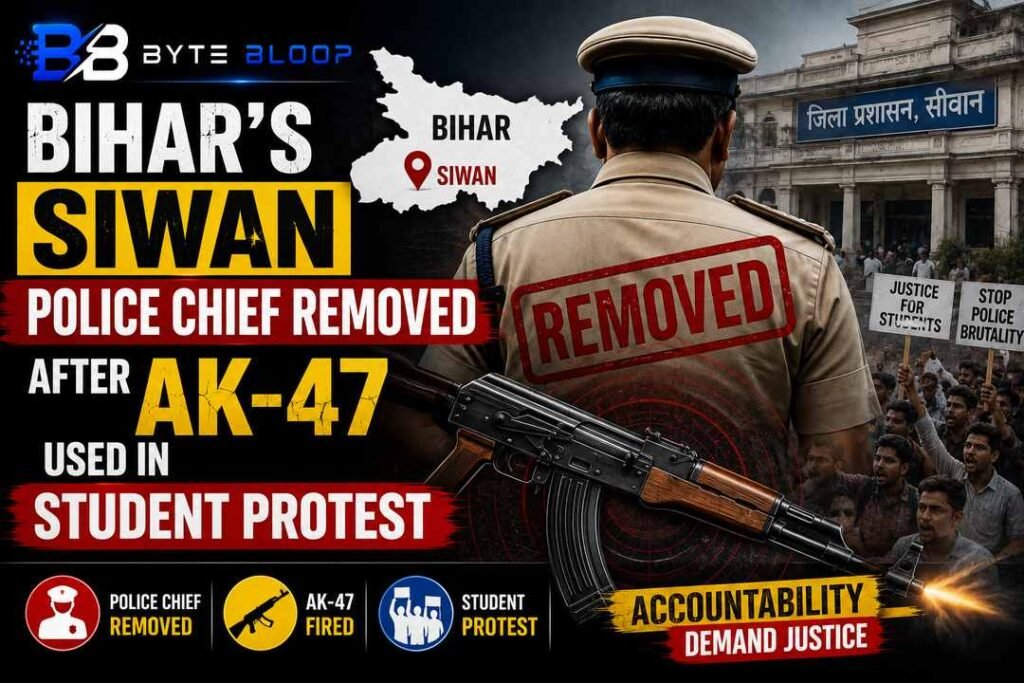
Bihar’s Siwan Police Chief Removed After AK‑47 Used in Student Protest
Introduction
In a dramatic turn of events, the senior police officer overseeing Siwan district in Bihar was removed from his post after an AK‑47 rifle was discharged during a student protest in July. The incident, which left the public shocked and the media buzzing, has intensified calls for stricter oversight of law‑enforcement agencies in the state. While the constable who allegedly fired the weapon has already been suspended, senior officers who were on duty at the time have yet to receive new postings, raising questions about accountability at the highest levels.
The protests, originally sparked by grievances over academic fees and alleged administrative bias, quickly escalated when a group of students gathered outside the district’s administrative building. What began as a peaceful sit‑in turned volatile when police attempted to disperse the crowd, culminating in the discharge of an automatic rifle. The episode has become a flashpoint in the ongoing debate over the use of excessive force by Indian police forces.
Background & Historical Context
Siwan, a district in north‑west Bihar, has a history of student activism dating back to the 1970s, when campus movements played a pivotal role in shaping regional politics. Over the past decade, however, the region has seen a rise in tensions between students and local authorities, often fueled by disputes over fee structures, campus infrastructure, and alleged favoritism in admissions.
In recent years, the Indian government has introduced several reforms aimed at curbing police brutality, including the 2022 amendment to the Police Act that mandates body‑camera usage and stricter disciplinary procedures. Despite these measures, incidents of excessive force continue to surface, especially in states with high political volatility. The Siwan episode is the latest reminder that policy changes alone may not be sufficient without robust implementation and cultural shifts within law‑enforcement agencies.
Key Details & Impact Analysis
According to official statements released by the Bihar Police, the constable who fired the AK‑47 was part of a rapid‑response team deployed to control the protest. The weapon, reportedly a legacy piece from a stockpile of older arms, was allegedly discharged unintentionally while the officer attempted to secure it. The constable was immediately suspended pending a formal inquiry, and a forensic team was tasked with examining the firearm and the scene.
The removal of the district’s top cop, identified as Senior Superintendent of Police (SSP) Puran Kumar Jha, underscores the administration’s attempt to demonstrate zero tolerance for misuse of force. Critics argue that the decision is largely symbolic, pointing out that no senior officers have been reassigned or faced disciplinary action yet. The incident has already prompted student unions across Bihar to demand a comprehensive probe, the establishment of an independent oversight committee, and the introduction of non‑lethal crowd‑control tools in place of firearms.
Frequently Asked Questions (FAQs)
What exactly happened during the July protest in Siwan?
Students gathered to protest fee hikes and alleged administrative bias. Police were called in to disperse the crowd, and during the operation a constable allegedly fired an AK‑47, injuring a bystander. The constable was suspended, and the district’s senior police officer was later removed from his post.
Has anyone been held legally responsible for the shooting?
As of now, only the constable who fired the weapon has been suspended pending investigation. No senior officers have faced legal action, though the state government has announced an internal inquiry and promised to forward findings to the judiciary if warranted.
How will this incident affect future student protests in Bihar?
The episode is expected to heighten vigilance among student groups, who are now demanding stricter protocols for police deployment at campuses. It may also prompt the state to adopt non‑lethal crowd‑control equipment, such as water cannons and tear‑gas, and to increase training on de‑escalation techniques.
Conclusion
The Siwan incident serves as a stark reminder that the balance between maintaining public order and safeguarding civil liberties remains fragile in many parts of India. While the removal of the district’s senior police officer signals a willingness to address the misuse of force, the lack of immediate action against other senior officials suggests that deeper systemic reforms are still needed. As students, activists, and policymakers watch closely, the outcome of the ongoing investigations could set a precedent for how law‑enforcement agencies handle campus unrest across the nation.
Source: NDTV