Digital Twins: Explained
Introduction
Digital twins are more than a buzzword; they are a digital replica of a physical object, system, or process that mirrors its real‑world counterpart in real time. By ingesting data from sensors, IoT devices, and enterprise systems, a digital twin continuously updates its state, enabling predictive analytics, scenario testing, and remote monitoring. The concept dates back to the 1960s, but recent advances in cloud computing, AI, and edge analytics have unlocked scalable, real‑time applications across manufacturing, healthcare, smart cities, and even climate modeling. Companies now deploy digital twins to optimize production lines, reduce downtime, and simulate design changes without costly physical prototypes. In the next few sections, we’ll unpack how digital twins function, explore key use cases, and discuss the challenges that accompany their adoption. Whether you’re a technologist, a business leader, or simply curious, understanding digital twins will help you see how data-driven simulations are shaping tomorrow’s products and services.
How Digital Twins Work
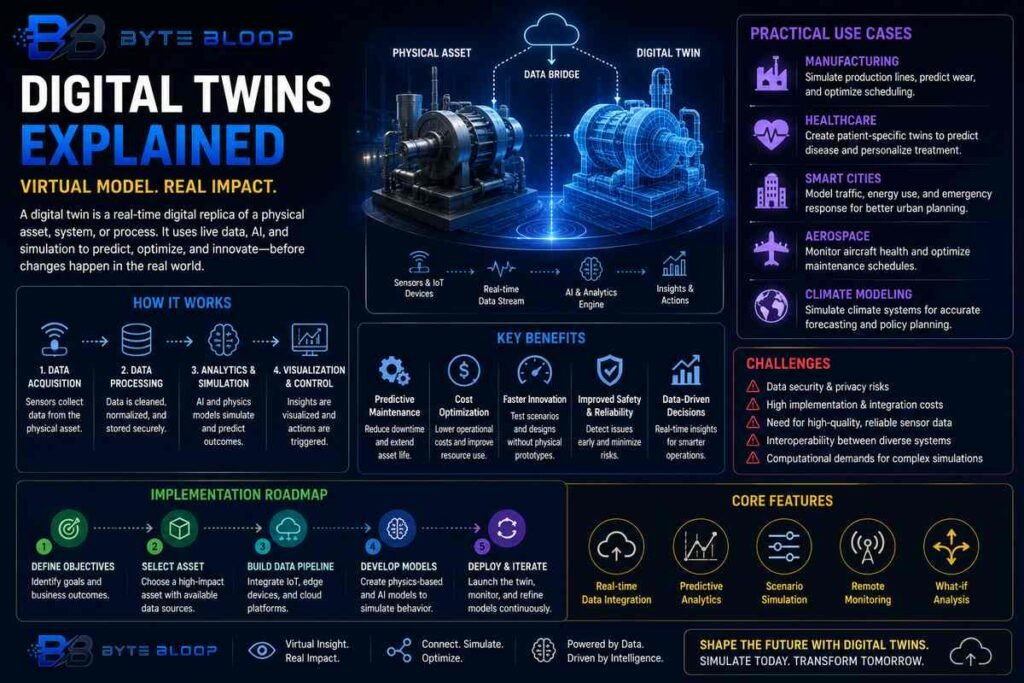
A digital twin comprises three core components: the physical asset, the digital replica, and the data bridge that synchronizes the two. Sensors embedded in the physical asset send telemetry—temperature, pressure, vibration, and more—to a cloud or edge platform. Machine‑learning models process this stream, updating the digital model’s parameters and generating insights. The digital twin can then run simulations, forecast failures, or test design tweaks before any changes reach the real world. This closed loop of observation, analysis, and action is what gives digital twins their power.
Architectural Foundations
Modern digital twins rely on a layered architecture: (1) Data Acquisition collects raw telemetry; (2) Data Processing cleans, normalizes, and stores the data; (3) Analytics & Simulation applies AI models and physics‑based engines; and (4) Visualization & Control presents insights and enables remote interventions. The flexibility of this stack allows integration with legacy systems, 5G networks, and even planetary‑scale climate models, as recent research demonstrates.
Practical Use Cases
Manufacturing – Companies simulate assembly lines, predict wear, and optimize scheduling, cutting downtime by up to 30%. Healthcare – Patient‑specific digital twins forecast disease progression and personalize treatment plans. Smart Cities – Urban planners model traffic flows, energy consumption, and emergency response scenarios. Aerospace – Aircraft digital twins monitor structural health and inform maintenance schedules. In each scenario, the twin’s ability to test “what if” scenarios without physical risk is a game‑changer.
Benefits and Challenges
Digital twins offer significant benefits: enhanced predictive maintenance, accelerated product development, and improved operational efficiency. However, they also pose challenges such as data security, interoperability between heterogeneous systems, and the need for high‑quality sensor networks. Moreover, the computational cost of running detailed simulations can be substantial, especially for large‑scale or real‑time applications.
Implementation Roadmap
1. Define Objectives: Identify business goals—cost reduction, safety improvement, or innovation acceleration. 2. Select Asset: Choose a high‑impact physical system with available sensors. 3. Build Data Pipeline: Integrate IoT devices, edge gateways, and cloud services. 4. Develop Models: Use physics‑based and data‑driven models to simulate behavior. 5. Deploy & Iterate: Launch the twin, monitor performance, and refine models based on feedback.
Key Takeaways
- Digital twins mirror physical assets in real time, enabling predictive analytics and scenario testing.
- They rely on a layered architecture of data acquisition, processing, analytics, and visualization.
- Key industries include manufacturing, healthcare, smart cities, aerospace, and climate modeling.
- Benefits include cost savings and faster innovation, but challenges such as data security and high computational demands remain.
- Successful adoption requires clear objectives, robust sensor networks, and iterative model refinement.
Frequently Asked Questions
What is a digital twin?
A digital twin is a virtual model that mirrors a physical object or system, continuously updated with real‑time data to reflect its real‑world counterpart.
What are the key features of digital twins?
Key features include real‑time data integration, predictive analytics, simulation capabilities, and the ability to run ‘what‑if’ scenarios without affecting the physical asset.
What are the best use cases for digital twins?
Manufacturing for predictive maintenance, healthcare for personalized treatment plans, smart cities for traffic and energy modeling, aerospace for structural health monitoring, and climate science for planetary‑scale simulations.
What are the pros and cons of digital twins?
Pros: cost reduction, faster product development, and enhanced decision‑making. Cons: data security risks, high implementation costs, and the need for high‑quality sensor data.
Conclusion
Based on the available information and industry analysis, digital twins provide a powerful bridge between the physical and virtual worlds, enabling organizations to predict, optimize, and innovate with unprecedented precision. By integrating real‑time data, advanced analytics, and simulation, they unlock new efficiencies across manufacturing, healthcare, and urban planning, while also presenting challenges that require careful governance and investment. The continued evolution of cloud, edge, and AI technologies will only deepen the impact of digital twins, positioning them as a cornerstone of the digital‑first future.
Related Reading
- AI in Manufacturing: Boosting Efficiency with Smart Sensors
- The Rise of Edge Computing: Powering Real‑Time IoT