Game Streaming: Explained
Introduction
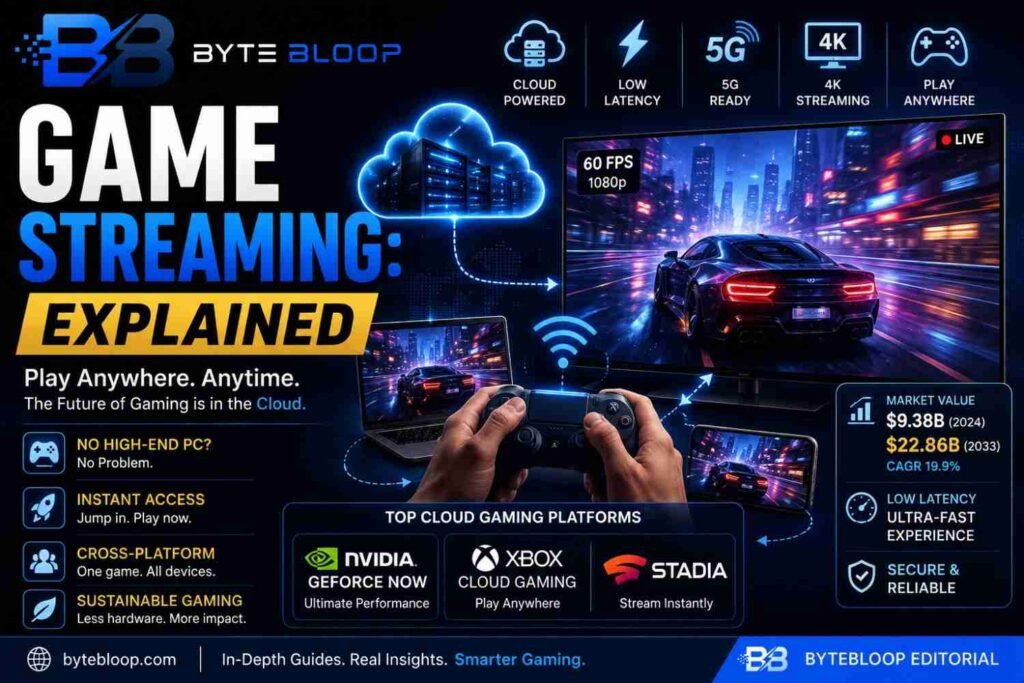
Game streaming has reshaped how players experience titles, moving the heavy lifting from local hardware to powerful remote servers. At its core, it delivers real‑time gameplay video and audio to a viewer’s device, while capturing input from a keyboard, controller, or touch screen and sending it back to the server for processing. This loop relies on ultra‑low latency, high bandwidth, and adaptive compression to keep the experience smooth, even over congested networks. The rise of cloud gaming platforms like GeForce Now, Xbox Cloud Gaming, and emerging services in 2026 has turned streaming from a niche hobby into a mainstream entertainment channel. For developers, it opens new distribution avenues, while gamers can access AAA titles without owning expensive rigs. The market, valued at $9.38 billion in 2024, is projected to surpass $22.86 billion by 2033, reflecting rapid adoption and innovation. Understanding the technology, market dynamics, and practical steps to get started is essential for anyone looking to tap into this evolving ecosystem. Below we break down the key components, current trends, and how you can jump in today.
How Game Streaming Works
At its simplest, game streaming mirrors the classic client‑server model: a remote server runs the game, captures frames, compresses them, and streams the video to the user. The user’s device sends input back to the server, which updates the game state. The entire process hinges on three pillars: low‑latency networking, high‑resolution encoding, and robust cloud infrastructure. Modern codecs like H.264 and the newer AV1, combined with hardware acceleration on GPUs, enable 60 fps streams at 1080p or higher with acceptable lag.
Key Technologies Driving the Industry
1. Edge Computing – By placing servers closer to end users, edge nodes reduce round‑trip time, a critical factor for competitive gaming. 2. AI‑Based Upscaling – NVIDIA’s DLSS 4 and similar technologies upscale lower‑resolution frames to 4K, cutting bandwidth while preserving visual fidelity. 3. 5G and Future Networks – The rollout of 5G promises sub‑10 ms latency, opening the door for mobile cloud gaming at home speeds. 4. Adaptive Bitrate Streaming – Protocols like WebRTC and QUIC dynamically adjust quality based on network conditions, ensuring a smooth experience even on fluctuating connections.
Market Landscape in 2026
The game streaming value chain is highly complex, intertwining hardware, software, content licensing, and monetization models. Major players such as NVIDIA, Microsoft, and Google invest heavily in proprietary cloud infrastructures, while indie developers increasingly use platforms like Stadia, Xbox Cloud Gaming, and emerging services listed in 2026 reviews. Consumer demand is driven by the ability to play high‑end games on low‑spec devices, cross‑platform play, and the convenience of instant access. The projected CAGR of nearly 20% between 2025 and 2033 underscores the sector’s growth trajectory.
Getting Started: Gear and Setup
While cloud platforms handle the heavy lifting, a good streaming setup still requires reliable hardware and software. A high‑speed internet connection (minimum 25 Mbps upload for 1080p at 60 fps) is essential. For local streaming, a capture card (e.g., Elgato HD60) paired with a powerful PC and a streaming encoder like OBS Studio or Streamlabs provides the foundation. For cloud gaming, all you need is a compatible device—smartphone, tablet, laptop, or smart TV—and a subscription to a service such as GeForce Now, Xbox Cloud Gaming, or the upcoming services highlighted in 2026 reviews.
Best Use Cases for Game Streaming
1. Content Creators – Streamers can broadcast gameplay without investing in a high‑end rig, reducing hardware costs and allowing focus on production quality. 2. Gamers on a Budget – Players can access AAA titles on modest devices, eliminating the need for expensive PCs or consoles. 3. Cross‑Platform Play – Cloud services enable players on different hardware to compete in the same session, fostering a unified community. 4. Enterprise Training – Simulations and training modules can be streamed to employees worldwide, ensuring consistent experiences.
Pros and Cons of Game Streaming
Pros:
- Cost‑effective hardware requirements
- Instant access to a vast library
- Scalable infrastructure for developers
- Reduced environmental impact due to shared resources
Cons:
- Dependence on stable, high‑bandwidth internet
- Potential latency issues for competitive play
- Subscription fees can add up
- Limited offline availability
Future Outlook
Emerging trends such as AI‑driven latency reduction, 5G‑enabled mobile cloud gaming, and the integration of virtual reality into streaming are poised to push the industry forward. As network infrastructure improves and content libraries expand, game streaming is set to become the default mode of game consumption, blurring the line between traditional console play and cloud‑based experiences.
Key Takeaways
- Game streaming delivers real‑time gameplay via low‑latency cloud servers
- Edge computing and AI upscaling reduce bandwidth while preserving quality
- The market is growing rapidly, projected to reach $22.86B by 2033
- Successful streaming requires robust internet and reliable hardware or a subscription
- Future trends include 5G, VR integration, and AI‑enhanced latency management
Frequently Asked Questions
What is game streaming explained?
Game streaming is the delivery of real‑time video game content from a remote server to a viewer’s device, with user input sent back to the server for processing. It relies on low‑latency networks, high‑bandwidth encoding, and powerful cloud infrastructure.
What are the key features of game streaming services?
Key features include instant access to a large library, cross‑platform compatibility, AI‑based upscaling (e.g., DLSS 4), adaptive bitrate streaming, and edge‑computing to reduce latency.
What are the best use cases for game streaming?
Content creators can stream without expensive rigs, budget gamers can play AAA titles on low‑spec devices, cross‑platform play unifies communities, and enterprises can deliver consistent training simulations.
What are the pros and cons of game streaming?
Pros: cost‑effective hardware, instant library access, scalable for developers, lower environmental impact. Cons: requires stable high‑speed internet, potential latency for competitive play, subscription costs, limited offline use.
Conclusion
Based on the available information and industry analysis, game streaming is rapidly redefining how players access and experience games, driven by advances in low‑latency networking, AI upscaling, and edge computing. As the market grows toward $22.86 billion by 2033, both consumers and developers stand to benefit from more flexible, cost‑effective, and scalable gaming solutions.
Related Reading
- The Rise of Cloud Gaming in 2026