Kindle Devices: Explained
Introduction
For the past decade, Amazon’s Kindle has dominated the e‑reader market, offering a lightweight, battery‑long experience that has reshaped how we consume books. By 2026, the lineup has expanded to twelve generations, with the latest models launched in July 2025, each iteration refining screen clarity, battery life, and ecosystem integration. The core appeal of a Kindle lies in its e‑ink display, which mimics paper and reduces eye strain, making it ideal for long reading sessions. However, the sheer variety—ranging from the entry‑level Kindle to the premium Paperwhite—can overwhelm newcomers and seasoned readers alike. Understanding the nuances of each model, from screen size to waterproofing, is essential to selecting the right device for your needs. This guide unpacks the current Kindle family, highlights key features, and offers practical buying advice to help you navigate the 2026 landscape. Whether you’re a casual reader, a voracious bookworm, or a gift buyer, the right Kindle can enhance your reading experience and save you money in the long run.
Overview of the Kindle Family
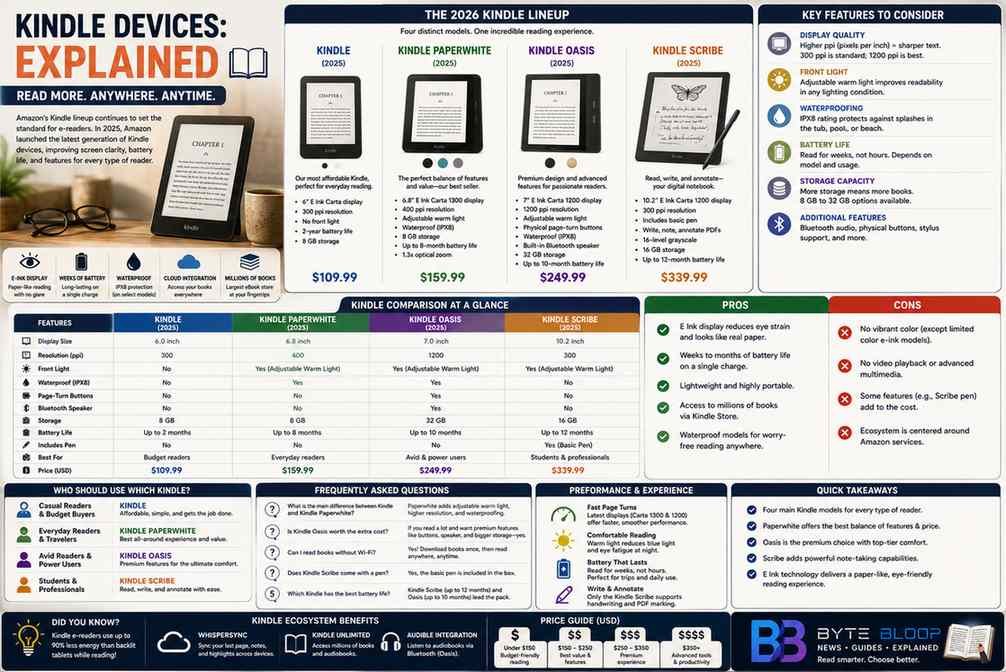
The 2026 Kindle lineup includes four main categories: the budget Kindle, the mid‑tier Kindle Paperwhite, the high‑end Kindle Oasis, and the newly released Kindle Scribe. Each tier targets a specific user profile.
Budget Kindle
Launched in 2025, the base model offers a 6‑inch E Ink Carta display, 300 ppi resolution, and a 2‑year battery life. It lacks front lighting but includes a 4‑month battery backup for power outages. Ideal for readers who prioritize price over features.
Kindle Paperwhite
The Paperwhite remains Amazon’s flagship. The 2025 revision adds a 400 ppi display, adjustable warm light, and 8‑month battery life. It also introduces a 1.3‑inch optical zoom feature for fine print. Waterproofing (IPX8) makes it suitable for kitchen or poolside use.
Kindle Oasis
Oasis is the premium model, featuring a 7‑inch Carta 1200 display, ergonomic design, and physical page‑turn buttons. The 2025 update brings a 10‑month battery life, a 10‑inch backlit screen for night reading, and a built‑in Bluetooth speaker for audiobooks. It’s the best choice for power users who want a feature‑rich experience.
Kindle Scribe
Introduced in 2025, the Scribe combines a 10.2‑inch E Ink display with a stylus, enabling note‑taking and PDF annotation. It supports 16‑color grayscale and offers 12‑month battery life. The Scribe is perfect for students, professionals, and anyone who wants to write directly on their e‑reader.
Key Features to Consider
- Display Quality – Higher ppi means sharper text; the Paperwhite and Oasis offer 400–1200 ppi.
- Front Lighting – Adjustable warm light improves readability in low light; the base Kindle lacks this.
- Waterproofing – IPX8 rating protects against accidental splashes, useful for kitchen or beach readers.
- Battery Life – Ranges from 2 to 12 months depending on usage; consider how often you read.
- Storage Capacity – 8 GB (base) to 32 GB (Oasis) accommodates thousands of titles.
- Additional Features – Audible integration, Bluetooth speakers, and stylus support differentiate the higher tiers.
Performance & Experience
All Kindle models use E Ink technology, which delivers a paper‑like reading experience with minimal glare. The 2025 Paperwhite’s 400 ppi screen provides crisp text, while the Oasis’s 1200 ppi display offers near‑print clarity. Users report that the warm light reduces eye fatigue during night sessions. Battery longevity is a standout; the Oasis’s 10‑month life means you can go months without charging, a major advantage for travelers. The Kindle Scribe’s stylus is responsive, with a latency of under 50 ms, making note‑taking feel natural. However, the Scribe’s larger form factor may feel bulky for some.
Pros and Cons
- Budget Kindle – Pros: Affordable, long battery, lightweight. Cons: No front light, lower resolution.
- Paperwhite – Pros: Balanced price, warm light, waterproof. Cons: Slightly heavier, no physical buttons.
- Oasis – Pros: Premium build, high resolution, physical buttons, Bluetooth speaker. Cons: Highest price, heavier.
- Scribe – Pros: Note‑taking, large screen, long battery. Cons: Expensive, stylus not included, heavier.
Who Should Use Which Kindle?
If you’re a casual reader on a budget, the base Kindle offers essential features at a low cost. Readers who want a versatile, waterproof device for all settings should opt for the Paperwhite. Frequent travelers, avid readers, or those who value a tactile interface will appreciate the Oasis. Students, writers, and professionals who need annotation capabilities should consider the Kindle Scribe.
FAQs
Key Takeaways
- The Kindle lineup offers four distinct tiers, from budget to premium.
- All models feature E Ink displays, ensuring a paper‑like reading experience.
- Waterproofing and adjustable warm light are key differentiators in mid‑tier models.
- The Kindle Scribe adds stylus support for note‑taking and PDF annotation.
- Battery life ranges from 2 to 12 months, making the Oasis ideal for frequent travelers.
Frequently Asked Questions
What is the main difference between the Kindle and Kindle Paperwhite?
The Kindle Paperwhite adds adjustable warm lighting, higher resolution, and waterproofing, making it more suitable for varied lighting conditions and environments.
What are the key features of the Kindle Oasis?
The Oasis boasts a 7‑inch 1200 ppi display, ergonomic design with physical page‑turn buttons, a 10‑month battery, and a built‑in Bluetooth speaker for audiobooks.
What are the best use cases for the Kindle Scribe?
The Scribe is ideal for students, professionals, and anyone who wants to annotate PDFs or take handwritten notes directly on a large e‑ink screen.
What are the pros and cons of the budget Kindle?
Pros include affordability, long battery life, and lightweight design. Cons are the lack of front lighting, lower resolution, and no waterproofing.
Conclusion
Based on the available information and industry analysis, the Kindle ecosystem continues to evolve, offering a spectrum of devices that cater to diverse reading habits—from the ultra‑budget Kindle to the feature‑rich Oasis and the annotation‑focused Scribe. Each model balances cost, performance, and portability, ensuring that whether you’re a casual reader or a professional note‑taker, there is a Kindle that meets your needs. The consistent use of E Ink technology guarantees a comfortable, eye‑friendly experience, while incremental improvements in lighting, waterproofing, and battery life keep Amazon’s flagship line competitive in 2026.
Related Reading
- Best E‑Readers of 2026: A Comparative Review