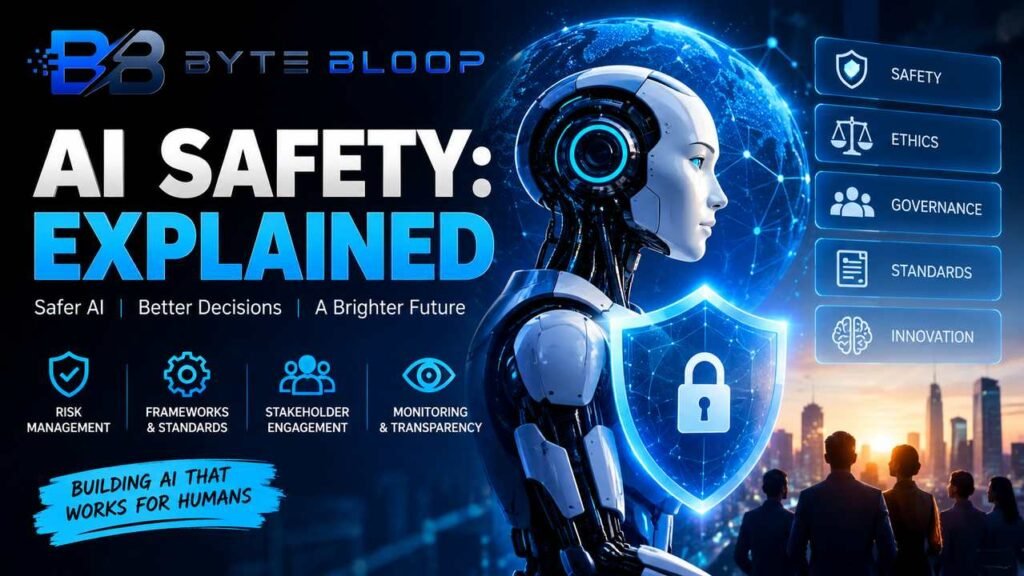
AI Safety: Explained
Introduction
Artificial intelligence safety is the discipline that seeks to ensure that AI systems behave in ways that are aligned with human values and do not produce unintended harm. The field has grown rapidly since the first AI safety report in 2015, driven by advances in large language models, autonomous vehicles, and decision‑support tools. Researchers argue that safety is not just a technical problem but also a governance and ethical challenge, requiring robust testing, transparency, and stakeholder engagement. In practice, AI safety involves aligning reward functions, building fail‑safe mechanisms, and continuously monitoring deployed systems for drift. The stakes are high: a misaligned model could amplify biases, cause financial loss, or even threaten national security. This article breaks down the core concepts, current best practices, and emerging frameworks that shape the industry’s approach to AI safety.
What Is AI Safety?
According to What Is AI Safety? A Complete Guide for 2026, AI safety closes the gap between trained behavior and acceptable production outcomes. It keeps systems aligned while preserving meaningful human oversight. The guide emphasizes that safety is a dynamic process, evolving as models grow in capability and complexity.
Key Safety Challenges
The International AI Safety Report 2026 highlights three primary hurdles: technical unpredictability, institutional inertia, and the rapid emergence of new capabilities. Managing general‑purpose AI risks is difficult because models can develop unanticipated behaviors once deployed. The report stresses the need for continuous monitoring and adaptive governance.
Frameworks and Standards
Governments and industry bodies are publishing risk‑management frameworks. The AI Risk Management Framework from NIST, released in April 2026, offers a structured approach for critical infrastructure operators. It recommends risk identification, impact assessment, and mitigation strategies tailored to specific AI use cases. International bodies such as UNESCO have issued ten core principles, including proportionality, do‑no‑harm, and safety and security, to guide policy makers and developers.
Industry Practices
Leading AI companies are increasingly publishing safety indices. The AI Safety Index – Summer 2026 aggregates expert ratings across safety and security domains. According to the index, companies that invest in interpretability tools and human‑in‑the‑loop oversight tend to score higher. The report also notes that transparency in model training data and objective performance metrics correlates with lower risk scores.
Practical Steps for Developers
- Align objectives: Define clear, measurable goals that reflect societal values.
- Implement guardrails: Use prompt‑engineering, content filters, and sandbox environments.
- Monitor post‑deployment: Deploy dashboards that track drift, bias, and anomalous outputs.
- Engage stakeholders: Include ethicists, domain experts, and end users in the design loop.
- Document assumptions: Maintain reproducible logs of data sources, hyperparameters, and test results.
Future Directions
Emerging research focuses on formal verification of neural networks, robust reinforcement learning, and explainable AI. The intersection of AI safety with other disciplines—such as economics, law, and cognitive science—promises to yield interdisciplinary solutions that balance innovation with protection.
Key Takeaways
- AI safety bridges technical alignment and ethical governance
- Risk management frameworks guide safe deployment in critical sectors
- Transparency and stakeholder engagement reduce unintended harm
- Continuous monitoring is essential as models evolve
- Industry safety indices help benchmark best practices
Frequently Asked Questions
What is AI safety?
AI safety is the field that ensures artificial intelligence systems act in ways that align with human values and do not cause unintended harm.
What are the key features of AI safety frameworks?
Key features include objective alignment, fail‑safe mechanisms, continuous monitoring, stakeholder engagement, and transparent documentation.
What are the best use cases for AI safety practices?
High‑stakes domains such as healthcare, autonomous transport, finance, and critical infrastructure benefit most from rigorous AI safety protocols.
What are the pros and cons of implementing AI safety measures?
Pros include reduced risk of harm, increased public trust, and regulatory compliance. Cons can be higher development costs, slower deployment, and potential over‑engineering.
Conclusion
Based on the available information and industry analysis, AI safety provides a structured approach to mitigating risks that arise when powerful models are deployed in real‑world settings. By combining technical safeguards, governance frameworks, and stakeholder collaboration, organizations can align AI behavior with societal values while preserving innovation. Continued research and standardization will be essential as the field evolves toward more autonomous and capable systems.
Related Reading
- Understanding AI Ethics in the Public Sector
Sources & References