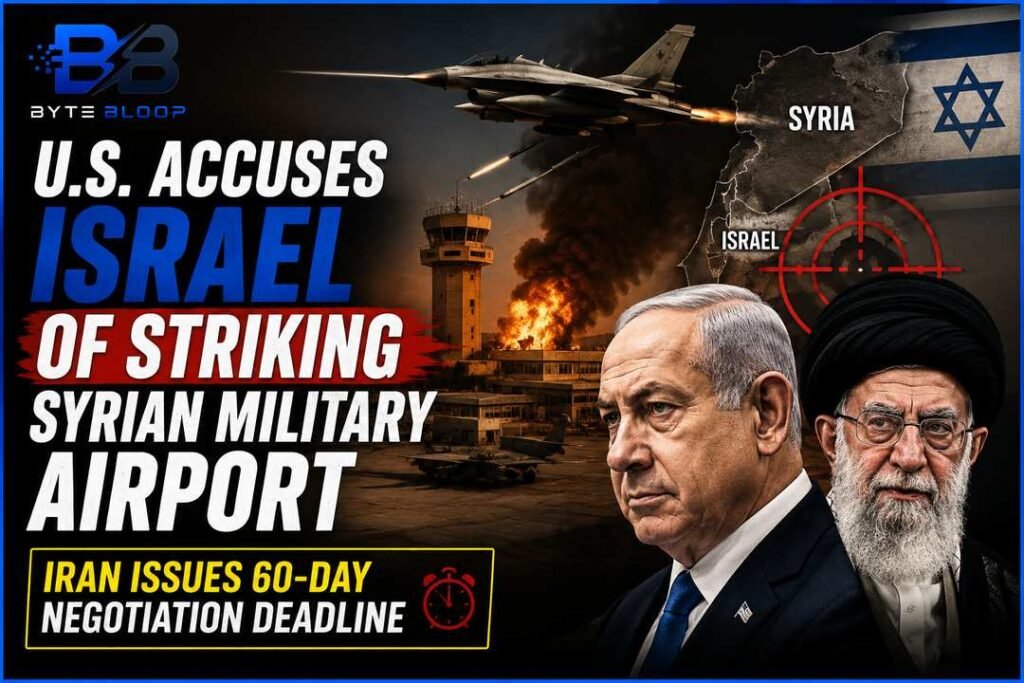
US Accuses Israel of Striking Syrian Military Airport Amid Rising Tensions
Introduction
The latest flashpoint in the already volatile Middle East emerged on Sunday when the United States officially declared that Israel was responsible for a series of airstrikes targeting a Syrian military airfield. The strikes, which took place in the early hours of the morning, have reignited concerns over a broader regional conflict involving Israel, Syria, Iran, and U.S. interests. As diplomatic channels scramble to contain the fallout, Tehran has simultaneously issued a stark warning: a 60‑day deadline for negotiations with the United States and its allies, after which any agreements will be deemed null and void.
These developments come at a time when the Middle East is already on edge, with ongoing clashes along the Israel‑Gaza frontier, Iranian proxy activity in Iraq and Lebanon, and a fragile cease‑fire that has held only intermittently. The U.S. statement adds a new layer of complexity, suggesting that the Israeli operation was aimed at degrading Syrian air‑defense capabilities that could be used by Iranian‑backed militias.
Background & Historical Context
Israel has a long history of conducting covert or semi‑covert strikes inside Syrian territory, especially against sites it believes are linked to Iranian weapons transfers. Since the Syrian civil war erupted in 2011, Damascus has become a conduit for Iranian Revolutionary Guard Corps (IRGC) forces and Hezbollah operatives to establish a strategic foothold near Israel’s borders. In recent years, Israeli officials have repeatedly hinted at pre‑emptive actions to neutralize what they describe as “imminent threats” emanating from Syrian airbases.
Meanwhile, the United States has maintained a delicate balancing act in the region. While it supports Israel’s right to self‑defence, Washington also seeks to prevent a full‑scale war that could destabilise oil markets and jeopardise its diplomatic outreach to Iran. The current 60‑day negotiation deadline announced by Tehran reflects Tehran’s frustration with stalled talks over its nuclear program and regional influence, adding urgency to an already tense diplomatic landscape.
Key Details & Impact Analysis
The Syrian military airport targeted in the recent strikes is believed to be located near the city of Palmyra, a strategic hub that houses both Syrian Air Force assets and Iranian‑supplied missile systems. Satellite imagery released by independent analysts shows significant runway damage and the destruction of several aircraft shelters. Syrian state media condemned the attack as a violation of sovereignty, while Israel’s defense ministry declined to comment, adhering to its long‑standing policy of strategic ambiguity.
From an impact perspective, the strike serves multiple purposes. For Israel, it potentially cripples a node that could facilitate the transfer of advanced weaponry to Hezbollah in Lebanon. For the United States, publicly attributing the attack to Israel signals a willingness to hold its ally accountable for actions that could destabilise the region, thereby preserving its credibility as a mediator. However, the move also risks straining the U.S.–Israel security partnership, especially if Washington faces domestic pressure to curb Israeli aggression.
Iran’s 60‑day deadline adds another variable. Should diplomatic negotiations fail, Tehran has hinted at expanding its proxy operations, which could include increased missile launches from Syrian territory or intensified support for militias in Iraq and Yemen. Such escalation would likely provoke a stronger Israeli response, potentially leading to a cycle of retaliation that could draw in the United States, either directly or through its regional partners.
Frequently Asked Questions (FAQs)
What evidence does the U.S. have that Israel carried out the Syrian strike?
The United States cited a combination of satellite imagery, signals intelligence, and corroborating reports from regional allies. While Israel has not confirmed involvement, its historical pattern of targeting similar facilities adds weight to the U.S. assessment.
How might Iran’s 60‑day negotiation deadline affect the situation?
If diplomatic talks collapse after the deadline, Iran has warned it will consider any agreements void, potentially escalating its support for proxy groups. This could lead to more frequent cross‑border attacks and increase the likelihood of a broader regional conflict.
Could this incident trigger a wider war involving the United States?
While direct U.S. military involvement remains unlikely in the immediate term, Washington could be compelled to intervene diplomatically or provide defensive support to Israel if hostilities expand. The situation remains fluid, and any escalation could draw the U.S. deeper into the conflict.
Conclusion
The U.S. accusation that Israel struck a Syrian military airport underscores the fragile equilibrium that defines Middle Eastern geopolitics. With Iran issuing a firm 60‑day deadline for negotiations and both Israel and the United States navigating a complex web of alliances and deterrence strategies, the region teeters on the brink of further escalation. Stakeholders on all sides must weigh the costs of military action against the imperative of diplomatic engagement, lest the latest flashpoint spirals into a larger, more destructive conflict.
Source: France 24