AI Education: Explained
Introduction
Artificial intelligence is no longer a futuristic buzzword; it is an everyday tool that is quietly transforming classrooms worldwide. From adaptive learning platforms that track a student’s progress to AI‑driven assessment tools that provide instant feedback, educators are leveraging machine learning to tailor instruction to individual needs. The rapid adoption of generative AI in 2026, highlighted by the OECD Digital Education Outlook, has broadened the scope of what AI can do—creating content, simulating conversations, and even predicting learning outcomes. Yet, with great power comes responsibility: schools must navigate data privacy, algorithmic bias, and the need for digital literacy. This article unpacks the core concepts of AI education, showcases real‑world examples, and offers guidance on how to integrate AI responsibly while maximizing student benefit. It also addresses common misconceptions and provides actionable steps for educators, administrators, and parents to stay ahead of the curve. By the end, you’ll understand how AI can enhance learning, the ethical considerations involved, and the practical steps to implement AI tools effectively.
What AI Means for Learning
At its core, AI in education uses algorithms to analyze data and make decisions that would normally require human judgment. In practice, this translates to:
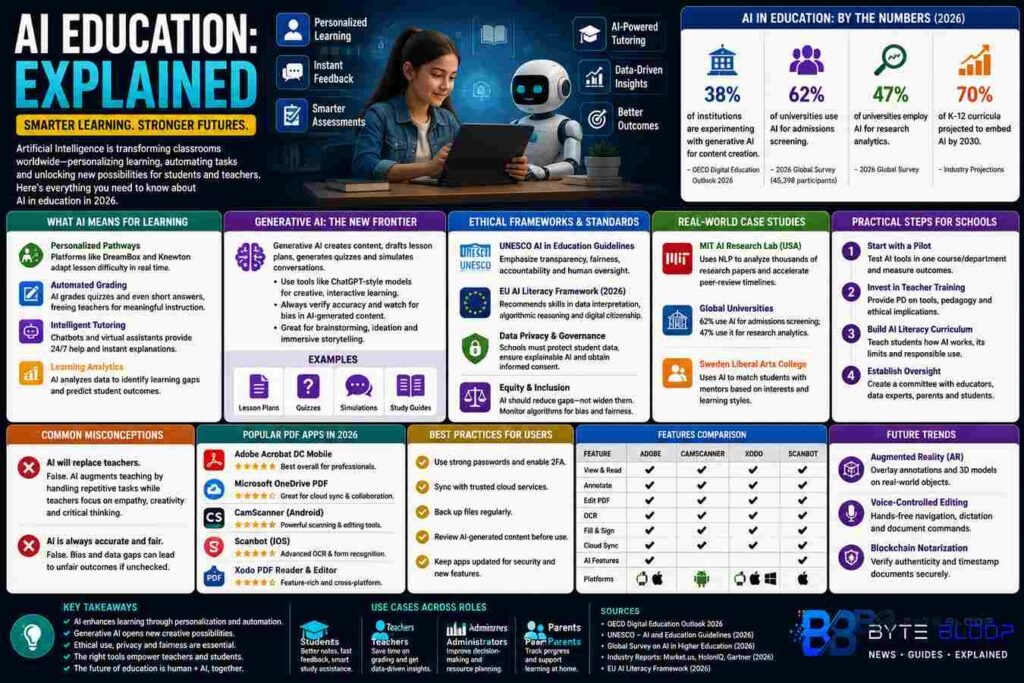
- Personalized pathways: Systems like DreamBox and Knewton adapt lesson difficulty in real time.
- Automated grading: AI can grade multiple‑choice and even short‑answer responses, freeing teachers to focus on higher‑order instruction.
- Intelligent tutoring: Chatbots and virtual assistants answer student questions 24/7, providing instant support.
Generative AI: The New Frontier
The OECD Digital Education Outlook 2026 reports that 38% of institutions are experimenting with generative AI for content creation. Tools such as ChatGPT‑style models can draft lesson plans, generate quizzes, and even simulate historical figures for immersive learning. However, educators must vet outputs for accuracy and bias, as AI can inadvertently reinforce stereotypes if not carefully monitored.
Ethical Frameworks and Standards
UNESCO’s AI in Education guidelines emphasize transparency, fairness, and accountability. Schools adopting AI should establish clear data governance policies, ensuring student information is protected and algorithms are explainable. The new AI Literacy Framework from the EU, released in 2026, recommends that learners acquire skills in data interpretation, algorithmic reasoning, and digital citizenship.
Case Studies in Higher Education
A 2026 global survey of 45,398 participants revealed that 62% of universities use AI for admissions screening, while 47% employ it for research analytics. In the United States, MIT’s AI‑powered research lab uses natural language processing to sift through thousands of papers, accelerating peer‑review timelines. Meanwhile, a small liberal arts college in Sweden uses AI to match students with mentors based on interests and learning styles.
Practical Steps for Schools
- Start with a pilot: Choose a single course or department to test AI tools, measure outcomes, and gather feedback.
- Invest in teacher training: Provide professional development that covers both technical use and ethical implications.
- Build an AI literacy curriculum: Integrate modules that teach students how AI works, its strengths, and its limitations.
- Establish oversight committees: Include educators, data scientists, parents, and students to review AI deployments.
Common Misconceptions
Many believe AI will replace teachers entirely. In reality, AI augments instruction, handling repetitive tasks and offering data insights, while human educators remain essential for empathy, critical thinking facilitation, and curriculum design. Another myth is that AI is infallible; algorithmic bias and data gaps can lead to unfair outcomes if unchecked.
Future Outlook
By 2030, projections suggest AI will be embedded in 70% of K‑12 curricula worldwide, with advanced analytics driving policy decisions at the district level. Continuous research, such as the OECD’s 2026 Outlook, will shape best practices, ensuring AI serves as a tool for equity rather than inequality.
Key Takeaways
- AI personalizes learning pathways and speeds up grading.
- Generative AI expands content creation but requires careful vetting.
- Ethical guidelines from UNESCO and the EU emphasize transparency.
- Higher education uses AI for admissions, research, and mentorship.
- Schools should pilot, train staff, and build oversight for responsible use.
Frequently Asked Questions
What is AI education explained?
AI education explained refers to the use of artificial intelligence technologies—such as adaptive learning, automated grading, and generative content creation—to enhance teaching, learning, and assessment processes.
What are the key features of AI tools in classrooms?
Key features include personalized lesson plans, real‑time feedback, automated assessment, intelligent tutoring, and data‑driven insights that help teachers adjust instruction.
What are the best use cases for generative AI in schools?
Generative AI excels at drafting lesson materials, creating quizzes, simulating interactive scenarios, and providing instant student support through chatbots.
What are the pros and cons of adopting AI in education?
Pros: increased personalization, efficiency, and data insights. Cons: potential bias, privacy concerns, and the risk of over‑reliance on technology.
Conclusion
Based on the available information and industry analysis, AI education provides transformative opportunities for personalized learning, efficient assessment, and data‑driven decision making, while simultaneously raising critical ethical and equity considerations that educators must address to ensure inclusive and responsible deployment.
Related Reading
- The Rise of AI Tutors: How They’re Changing Homework
- Data Privacy in AI‑Powered Classrooms