6G: How It Works
Introduction (6g How It Works)
6g How It Works is a topic worth understanding well. Sixth‑generation wireless, or 6G, promises to redefine what mobile connectivity can achieve. While 5G is still rolling out, researchers and industry leaders already outline a future where data rates soar into the terabits per second, latency drops below one millisecond, and network reliability reaches new heights.
These advances are not just incremental; they enable a host of emerging applications—from holographic telepresence to autonomous industrial ecosystems—that were previously impossible. 6G is therefore seen as a catalyst for the next wave of digital transformation, linking people, devices, and data in ways that blur the boundary between the physical and virtual worlds. Its design will fuse radio, computing, and artificial intelligence into a single, intelligent fabric that can adapt to user needs in real time.
As telecom operators and technology firms race to secure patents and standards, the industry is already charting the path to 6G deployment by the mid‑2030s. Understanding how 6G works is essential for anyone looking to future‑proof their business or technology stack.
Core Principles of 6G Connectivity
At its heart, 6G extends the 5G architecture by adding new layers of intelligence and integration. The network will rely on higher frequency bands—up to 1 THz—allowing for wider bandwidths and faster data transfer. To counter the increased path loss at these frequencies, 6G will employ advanced beamforming and massive MIMO arrays that focus energy precisely where it is needed. This approach reduces interference and improves energy efficiency, a critical factor as the number of connected devices climbs to billions.
Artificial Intelligence as a Network Backbone
Unlike 5G, where AI is largely an add‑on, 6G envisions AI as the core of network management. According to Ericsson’s research, intelligent fabric will enable real‑time collaboration between mobile, cloud, and edge systems. AI algorithms will predict traffic patterns, reallocate resources on the fly, and even generate synthetic network states for testing. This self‑optimizing capability is expected to lower operational costs while delivering the ultra‑low latency required for mission‑critical services.
This matters directly for anyone exploring 6g how it works.
Digital Twins and Sensing
6G is set to incorporate digital twin technology, creating virtual replicas of physical environments. Qualcomm’s studies suggest that these twins will allow devices to anticipate changes in the network environment and adjust parameters proactively. Combined with ultra‑high‑resolution sensing—capable of detecting motion, temperature, and chemical signatures—6G will enable immersive experiences such as real‑time holographic communication and autonomous vehicle coordination.
Getting 6g how it works right can make a real difference.
Seamless Integration of Physical and Virtual Realities
Nokia’s vision for 6G emphasizes a seamless blend of virtual and physical realities. By delivering consistent, high‑throughput connections across a wide spectrum, 6G will allow users to move effortlessly between augmented reality overlays and real‑world interactions. This fluidity will be powered by ultra‑low latency and massive device density, ensuring that digital content stays in sync with the physical world.
That is a core part of understanding 6g how it works.
Key Technological Enablers
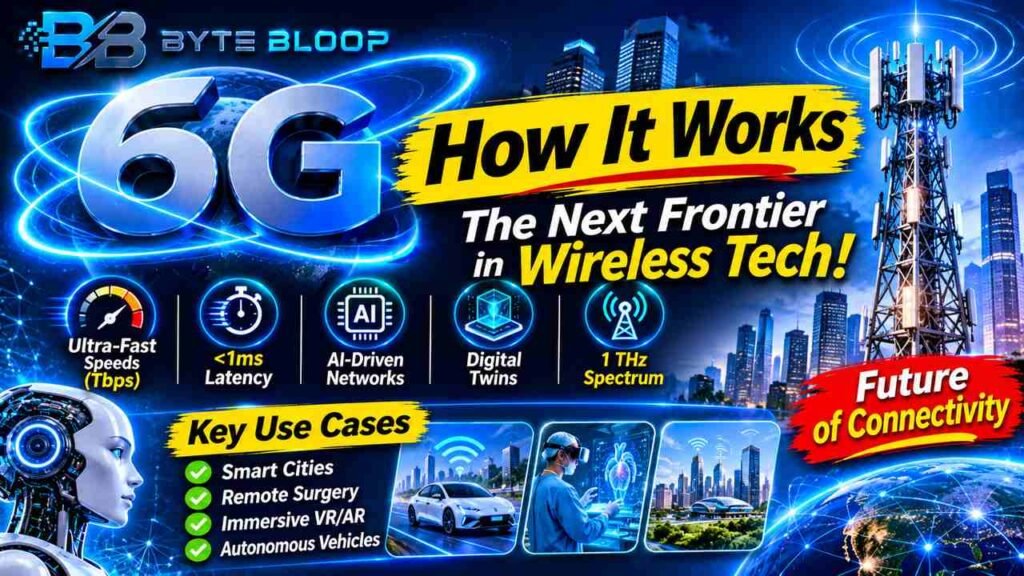
- Higher‑Frequency Spectrum – 6G will operate up to 1 THz, providing unprecedented bandwidth.
- Advanced Beamforming – Precise directional transmission reduces interference and extends range.
- Massive MIMO – Large antenna arrays increase capacity and spectral efficiency.
- Edge Computing – Localized processing cuts latency and offloads core network traffic.
- AI‑Driven Network Management – Predictive analytics optimize resource allocation in real time.
- Digital Twins & Sensing – Virtual replicas and high‑resolution sensing enhance situational awareness.
Practical Use Cases
While the technology is still in development, several use cases illustrate its potential impact. In healthcare, 6G could support real‑time remote surgery with sub‑millisecond latency. In manufacturing, autonomous robots could coordinate through a shared digital twin, reducing downtime. Urban planners might use 6G‑enabled sensors to monitor traffic flow and adjust signals instantly. In entertainment, fully immersive, multi‑user holographic concerts could become commonplace.
Many readers look into 6g how it works for exactly this reason.
Challenges and Considerations
Deploying 6G will not be without hurdles. The high‑frequency spectrum requires new antenna designs and power management solutions. Regulatory bodies must also allocate and protect these bands. Moreover, the integration of AI raises data privacy and security concerns that will need robust governance frameworks. Finally, the sheer scale—potentially 2.4 billion connections by 2035—demands unprecedented infrastructure investment.
It is worth revisiting 6g how it works as things develop.
Key Takeaways
- 6G will push data rates into terabits per second and cut latency below 1 ms
- AI will become the core of network management, enabling self‑optimizing traffic control
- Higher‑frequency bands up to 1 THz will unlock massive bandwidth but require advanced antenna tech
- Digital twins and ultra‑high‑resolution sensing will enable real‑time immersive experiences
- Deployment will need new regulatory frameworks and significant infrastructure investment
Frequently Asked Questions
What is 6G and how does it differ from 5G?
6G is the next generation of wireless technology that aims to deliver terabit‑per‑second data rates, sub‑millisecond latency, and integrated AI‑driven network management, building on the foundations of 5G but adding higher frequency bands and advanced sensing capabilities.
6g How It Works remains highly relevant here.
What are the key features of 6G?
Key features include operation up to 1 THz, massive MIMO and beamforming, edge computing, AI‑driven resource allocation, digital twins, and ultra‑high‑resolution sensing.
This is a key consideration when it comes to 6g how it works.
What are the best use cases for 6G?
Use cases span remote surgery, autonomous manufacturing, real‑time traffic management, immersive holographic entertainment, and smart city infrastructure, all requiring ultra‑low latency and massive connectivity.
This matters directly for anyone exploring 6g how it works.
What are the pros and cons of 6G?
Pros: unprecedented speed, reliability, AI integration, and new application possibilities. Cons: high deployment cost, regulatory challenges, power consumption at high frequencies, and privacy/security concerns.
Getting 6g how it works right can make a real difference.
Conclusion
Based on the available information and industry analysis, 6G represents a transformative leap in wireless connectivity, promising terabit‑per‑second speeds, sub‑millisecond latency, and AI‑driven network intelligence that will enable immersive, real‑time applications across healthcare, manufacturing, and entertainment. While its rollout faces technical, regulatory, and economic challenges, the potential benefits position 6G as a cornerstone of future digital ecosystems.
Related Reading
- 5G vs 6G: What’s the Difference?
Sources & References
- 6G – Follow the journey to the next generation networks
- 6G from launch to scale: 2.4 billion connections by 2035
- 6G: The Future of Mobile Connectivity & Wireless Tech
- How will 6G take connectivity to the next level?
- Simply explained: 6G technology | EY – UK
- Charting the path to 6G | Nokia.com
Related Articles