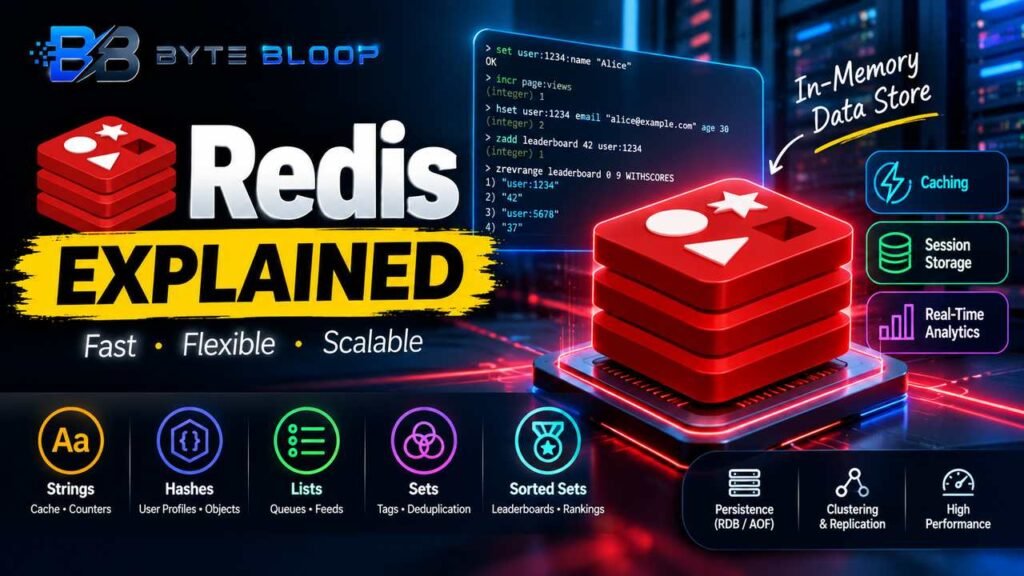
Redis: Explained
Introduction (Redis explained)
Redis explained is a topic worth understanding well. Redis, short for Remote Dictionary Server, is an open‑source, in‑memory data store that has become the go‑to solution for high‑performance caching, session storage, and real‑time analytics. Its ability to hold data entirely in RAM means that read and write operations can be completed in microseconds, a speed that is critical for latency‑sensitive applications such as gaming leaderboards, ad bidding, and e‑commerce inventory checks.
Unlike traditional relational databases, Redis treats data as a collection of rich data structures—strings, hashes, lists, sets, sorted sets, and hyperloglogs—each optimized for specific access patterns. This flexibility allows developers to model complex relationships without the overhead of joins or foreign keys. The open‑source community has built a robust ecosystem of client libraries for virtually every programming language, making integration straightforward. Moreover, Redis now offers clustering, persistence options, and built‑in replication, turning it from a simple cache into a production‑ready data store.
Understanding how Redis works, when to use it, and how to avoid common pitfalls is essential for any developer looking to build scalable, responsive systems.
How Redis Stores Data
At its core, Redis keeps all data in RAM, but it also supports optional persistence to disk through snapshots (RDB) or an append‑only file (AOF). The in‑memory nature eliminates disk I/O bottlenecks, while persistence guarantees durability across restarts. Redis organizes data into a single global keyspace, where each key points to a value of a specific data type. For example, a string key might hold a user token, while a hash key could store a user profile with multiple fields.
Key Data Structures and Use Cases
- Strings – The simplest type, ideal for caching API responses or storing counters.
- Hashes – Map-like structures perfect for representing objects with many fields, such as user profiles or product catalogs.
- Lists – Ordered collections used for message queues, task scheduling, or activity feeds.
- Sets – Unordered collections that support fast membership tests, useful for tag systems or deduplication.
- Sorted Sets – Sets with a score per member, enabling leaderboard ranking or time‑based queries.
Basic Commands and Example Workflow
Below is a quick example of how to set up Redis, connect, and perform common operations using the Node.js client ioredis. The same pattern applies to other languages.
const Redis = require('ioredis');
const redis = new Redis(); // defaults to localhost:6379

// Set a simple string
await redis.set('user:1234:name', 'Alice');

// Increment a counter
await redis.incr('page:views');

// Store a hash
await redis.hmset('user:1234', { email: 'alice@example.com', age: 30 });

// Add to a sorted set (leaderboard)
await redis.zadd('leaderboard', 42, 'user:1234');

// Retrieve the top 10 users
const top = await redis.zrevrange('leaderboard', 0, 9, 'WITHSCORES');
console.log(top);
These commands demonstrate Redis’ versatility: a single instance can act as a cache, a counter, a message queue, and a leaderboard simultaneously.
Common Pitfalls and How to Avoid Them
- Over‑caching – Storing data that rarely changes in Redis can waste memory. Use TTLs (time‑to‑live) to automatically expire stale keys.
- Ignoring persistence settings – Default configurations may not suit production workloads. Choose RDB for fast restores or AOF for higher durability.
- Blocking commands in single‑threaded mode – Redis runs a single event loop; heavy blocking operations can stall all clients. Offload CPU‑intensive work to separate processes.
- Not using clustering for large datasets – A single node is limited by available RAM. Use Redis Cluster or sharding to scale horizontally.
Best Practices for Production
- Use
EXPIREorSETEXto enforce TTLs on cache entries. - Enable
appendonlyfor write‑heavy workloads to reduce data loss risk. - Monitor memory usage with
INFO memoryand set alerts for fragmentation. - Leverage Lua scripting for atomic multi‑step operations to avoid race conditions.
- Implement client-side connection pooling to reduce connection overhead.
When to Use Redis
Redis shines when you need sub‑millisecond data access and can tolerate occasional data loss (with persistence configured). Typical scenarios include:
- Session storage for web applications.
- Real‑time analytics dashboards.
- Rate limiting and token buckets.
- Distributed locking mechanisms.
- Message brokering with Pub/Sub or Streams.
Key Takeaways
- Redis stores all data in RAM for lightning‑fast access
- Supports diverse data structures for flexible modeling
- Offers persistence options (RDB, AOF) for durability
- Built‑in clustering enables horizontal scaling
- Ideal for caching, real‑time analytics, and lightweight queues
Frequently Asked Questions
What is Redis?
Redis is an open‑source, in‑memory data structure store that serves as a database, cache, and message broker, providing sub‑millisecond read and write speeds.
What are the key features of Redis?
Redis supports rich data types (strings, hashes, lists, sets, sorted sets), persistence via RDB or AOF, clustering for scalability, Lua scripting for atomic operations, and Pub/Sub for messaging.
What are the best use cases for Redis?
Common use cases include session caching, real‑time analytics, leaderboard tracking, rate limiting, and lightweight message queues.
What are the pros and cons of Redis?
Pros: ultra‑fast access, versatile data types, strong community, and easy integration. Cons: memory‑bound, requires careful persistence configuration, and single‑threaded nature can cause blocking if not managed.
Conclusion
Based on the available information and industry analysis, Redis provides an exceptionally fast, flexible, and scalable solution for developers seeking high‑performance data storage and caching, making it a cornerstone technology for modern web and real‑time applications.
Related Reading
- Understanding Redis Persistence Options
Sources & References
- Redis Quick Start Guide: Install, Connect, and Query in Minutes
- Complete Guide to Redis in 2026: Components, Uses, and Architecture
- What is Redis Explained? | IBM
- A guide to fully understanding Redis
Related Articles