
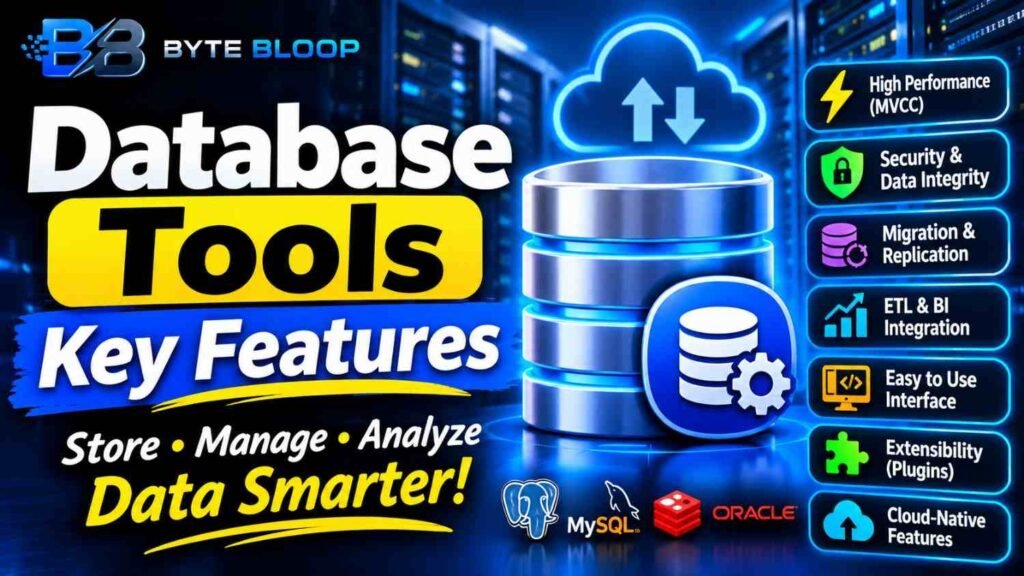
Database Tools: Key Features
Introduction (Database Tools Key Features)
Database Tools Key Features is a topic worth understanding well. Modern businesses generate and rely on data at an unprecedented pace. To keep pace, they turn to database tools—software that manages, secures, and optimizes data storage and retrieval. These tools range from lightweight spreadsheet‑style platforms to enterprise‑grade systems that support millions of concurrent users. A solid database tool not only stores data but also enforces integrity, automates routine tasks, and provides a developer‑friendly interface for querying and reporting. The right tool can reduce downtime, cut operational costs, and accelerate time‑to‑insight.
Understanding the core features that differentiate one tool from another is essential for data engineers, analysts, and business leaders alike. In this guide we break down the most critical features, illustrate real‑world use cases, and compare popular options in 2026. By the end, you’ll know how to align feature sets with your organization’s goals and constraints.
1. Multi‑Version Concurrency Control (MVCC)
MVCC allows multiple users to read and write data simultaneously without locking conflicts. According to the Best Database Management Software in 2026 blog, MVCC enhances concurrency and improves performance in high‑traffic environments. Tools like PostgreSQL, Oracle, and modern NoSQL engines implement MVCC to ensure that readers never block writers, and vice versa.
2. Automated Indexing and Query Optimization
Automated indexing reduces manual tuning, while query optimization engines rewrite queries for speed. The 9 database management best practices to know in 2026 article notes that built‑in automation for indexing and query tuning can streamline routine tasks and improve overall performance. DBVisualizer and other universal managers often include visual query planners that highlight bottlenecks.
This matters directly for anyone exploring database tools key features.
3. Data Integrity and Security Controls
Integrity constraints—such as primary keys, foreign keys, and unique indexes—prevent corrupt or duplicate records. Security features, including role‑based access control (RBAC) and encryption at rest, safeguard sensitive information. The Top Data Management Tools in 2026 blog emphasizes ensuring data integrity, security, and performance as top priorities for any data strategy.
Getting database tools key features right can make a real difference.
4. Migration and Replication Support
Seamless migration tools let organizations move schemas and data between servers or cloud providers with minimal downtime. Replication features—whether master‑slave, peer‑to‑peer, or multi‑master—enable high availability and disaster recovery. The Top 33 Database Management Tools In 2026 article lists migration and scheduling export capabilities as key differentiators.
That is a core part of understanding database tools key features.
5. Integration with ETL and BI Ecosystems
Modern database tools often expose connectors for ETL pipelines, data lakes, and BI platforms. Integration with Python, Spark, Tableau, and Excel allows analysts to pull data directly into their workflows. The SQL Tutorial For Beginners 2026 video highlights how tools support key concepts like ETL and exploratory data analysis.
Many readers look into database tools key features for exactly this reason.
6. User Interface and Developer Experience
Graphical interfaces, code editors, and API access shape the daily experience of developers and analysts. A unified interface that supports multiple database engines—like DBVisualizer—reduces context switching. The 8 Popular Database Management Tools article notes that professionals value tools that combine a clean UI with powerful scripting capabilities.
It is worth revisiting database tools key features as things develop.
7. Automation and Scheduling
Built‑in schedulers can automate backups, data exports, and routine maintenance tasks. According to the 9 database management best practices to know in 2026 article, automation reduces human error and frees up staff for higher‑value work.
Database Tools Key Features remains highly relevant here.
8. Extensibility and Plugin Ecosystem
Open‑source and commercial tools often support plugins or extensions that add new data types, analytics functions, or integration points. Baserow, highlighted in the Top Data Management Tools in 2026 blog, demonstrates how a flexible plugin system can tailor a database to specific business needs.
This is a key consideration when it comes to database tools key features.
9. Cloud‑Native Features
Native cloud support—such as automatic scaling, managed backups, and serverless execution—simplifies operations. Many 2026‑era tools offer hybrid deployments that let organizations keep sensitive data on-premises while leveraging cloud scalability.
This matters directly for anyone exploring database tools key features.
Choosing the Right Tool for Your Use Case
When evaluating database tools, match features to your priorities: performance for high‑traffic sites, automation for data pipelines, security for regulated industries, or cost for startups. For example, a small e‑commerce startup might favor a lightweight, cloud‑native solution like Baserow, whereas a financial institution may require Oracle’s robust security and MVCC capabilities.
Getting database tools key features right can make a real difference.
Practical Example: Migrating a Legacy MySQL Database
Suppose a mid‑size company needs to move from an on‑prem MySQL 5.7 database to a managed PostgreSQL instance. Using a tool that offers automated schema migration, the migration team can generate a migration plan, validate data integrity, and schedule a cutover window with minimal service interruption. The tool’s built‑in replication feature then keeps the new database in sync until the cutover is complete, ensuring zero data loss.
Key Takeaways
- MVCC boosts concurrency for high‑traffic applications
- Automated indexing and query optimization cut manual tuning
- Robust migration and replication features enable smooth upgrades
- Integrated ETL/BI connectors streamline analytics workflows
- Extensible plugin systems adapt tools to niche business needs
Frequently Asked Questions
What is MVCC and why is it important?
Multi‑Version Concurrency Control allows multiple users to access a database simultaneously without locking conflicts, improving performance and reducing wait times.
What are the key features of modern database tools?
Key features include MVCC, automated indexing, data integrity and security controls, migration and replication support, ETL/BI integration, user‑friendly interfaces, automation, extensibility, and cloud‑native capabilities.
What are the best use cases for database tools with automated indexing?
They are ideal for data warehouses, analytics platforms, and any environment where query performance is critical and manual tuning is costly.
What are the pros and cons of using a cloud‑native database tool?
Pros: automatic scaling, managed backups, reduced ops overhead. Cons: potential vendor lock‑in, higher long‑term cost, and limited control over underlying infrastructure.
Conclusion
Based on the available information and industry analysis, database tools that combine multi‑version concurrency control, automated indexing, robust migration, and cloud‑native features provide the most comprehensive support for modern data workloads. These capabilities enable organizations to scale efficiently, maintain high availability, and accelerate analytics, making them indispensable for data‑centric operations in 2026.
Related Reading
- Choosing the Right Database for Your Business
Sources & References
- Best Database Management Software in 2026 — Multi-Version Concurrency Control
- Top Data Management Tools in 2026
- 8 Popular Database Management Tools
- Essential Database Management Tools for Data Analysts
- 9 database management best practices to know in 2026
- SQL Tutorial For Beginners 2026 | Advanced SQL Course | Simplilearn
- Top 10 Database Administration Tools in 2026: Features, Pros, Cons & …
- Top 33 Database Management Tools In 2026
Related Articles


