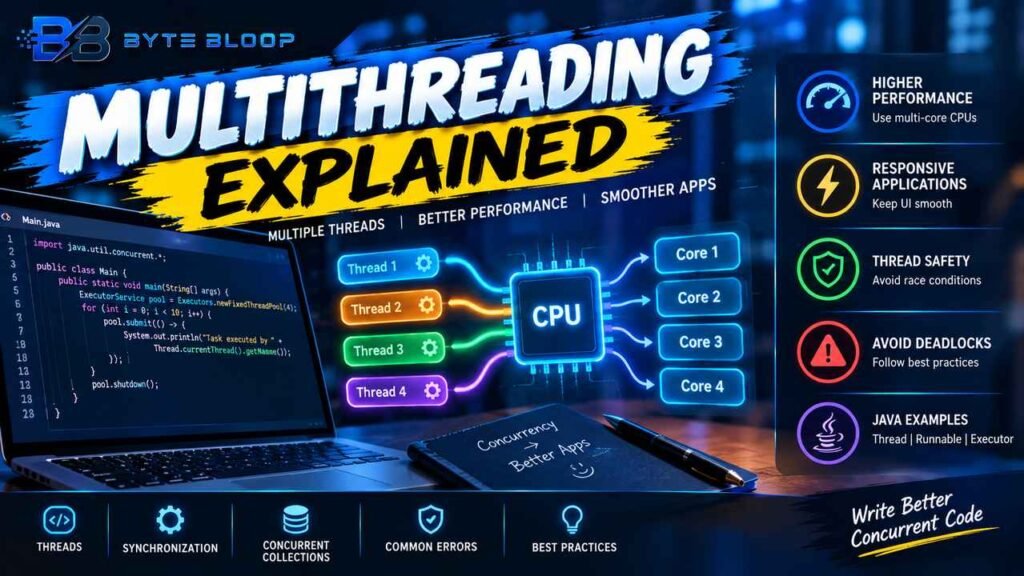
Multithreading: Explained
Introduction (Multithreading Explained)
Multithreading Explained is a topic worth understanding well. In modern software, performance and responsiveness are paramount. Multithreading is a foundational concept that enables a single program to execute multiple tasks concurrently, making better use of multi‑core processors and improving user experience. By dividing work into separate threads, a program can keep the user interface responsive while heavy calculations or I/O operations run in the background. Developers often encounter multithreading when building web servers, data pipelines, or real‑time applications that demand parallelism.
Yet, despite its ubiquity, many programmers struggle with thread safety, deadlocks, and synchronization overhead. This guide demystifies multithreading, covering core terminology, practical Java examples, common pitfalls, and industry best practices. Whether you’re a beginner preparing for interviews or a seasoned engineer optimizing production code, understanding multithreading will elevate your coding skill set and open doors to more efficient, scalable applications.
At its heart, a thread is a lightweight process that shares the same memory space with other threads in the same application. The operating system schedules these threads across available CPU cores, allowing true parallel execution. In Java, the Thread class and the Runnable interface provide the primary mechanisms to create and manage threads. Modern Java versions also offer the Executor framework, which abstracts thread creation and provides thread pools for efficient resource usage. The following sections walk through creating threads, coordinating them with synchronization primitives, and avoiding common concurrency bugs.
Creating Threads in Java
There are two classic ways to spawn a thread in Java: extending the Thread class or implementing Runnable. Extending Thread is straightforward but limits inheritance flexibility. Implementing Runnable is more versatile and aligns with composition over inheritance.
This matters directly for anyone exploring multithreading explained.
public class Counter implements Runnable {
    private int limit;
    public Counter(int limit) { this.limit = limit; }
    @Override
    public void run() {
        for (int i = 1; i <= limit; i++) {
            System.out.println(Thread.currentThread().getName() + ": " + i);
        }
    }
}

public class Main {
    public static void main(String[] args) {
        Thread t1 = new Thread(new Counter(5), "Counter‑1");
        Thread t2 = new Thread(new Counter(5), "Counter‑2");
        t1.start();
        t2.start();
    }
}
When start() is called, the JVM schedules the thread for execution, and the run() method executes concurrently with the main thread.
Getting multithreading explained right can make a real difference.
Thread Coordination and Synchronization
Because threads share memory, unsynchronized access can lead to data races. Java offers several synchronization tools: synchronized blocks, ReentrantLock, CountDownLatch, and higher‑level constructs like ExecutorService. A common pattern is to use a thread pool to limit the number of active threads and reduce context‑switch overhead.
That is a core part of understanding multithreading explained.
ExecutorService pool = Executors.newFixedThreadPool(4);
for (int i = 0; i < 10; i++) {
    pool.submit(new Counter(10));
}
pool.shutdown();
When multiple threads modify shared data, synchronized blocks ensure mutual exclusion:
Many readers look into multithreading explained for exactly this reason.
public class SharedCounter {
    private int count = 0;
    public synchronized void increment() {
        count++;
    }
    public synchronized int getCount() {
        return count;
    }
}
Using AtomicInteger or other atomic classes can provide lock‑free thread safety for simple counters.
It is worth revisiting multithreading explained as things develop.
Common Errors and How to Avoid Them
- Deadlocks – Occur when two or more threads wait indefinitely for resources held by each other. Avoid by acquiring locks in a consistent order and keeping critical sections short.
- Livelocks – Threads continuously change state in response to each other but make no progress. Detect by monitoring thread activity and applying back‑off strategies.
- Starvation – A thread never gets CPU time because higher‑priority threads dominate. Use fair locks or thread pools with priority queues to mitigate.
- Race Conditions – Unsynchronized access to shared mutable state. Employ
synchronized,volatile, or concurrent collections.
Best Practices for Multithreaded Java Applications
- Prefer the
Executorframework over manual thread creation to manage resources efficiently. - Use immutable objects where possible to eliminate synchronization needs.
- Leverage concurrent collections like
ConcurrentHashMapfor thread‑safe data structures. - Profile and monitor thread usage with tools such as VisualVM or Java Flight Recorder to identify bottlenecks.
- Write unit tests that cover concurrent scenarios, using frameworks like
JUnitwithCountDownLatchto orchestrate thread start times.
Key Takeaways
- Threads enable parallel execution and improve responsiveness.
- Java’s Executor framework simplifies thread management and reduces overhead.
- Synchronization primitives prevent race conditions but must be used judiciously to avoid deadlocks.
- Immutable objects and concurrent collections reduce the need for explicit locks.
- Profiling tools help detect contention and performance issues in multithreaded code.
Frequently Asked Questions
What is multithreading and why is it useful?
Multithreading is the ability of a program to run multiple threads concurrently, allowing tasks to execute in parallel and improving performance and responsiveness.
Multithreading Explained remains highly relevant here.
What are the key features of Java multithreading?
Java provides the Thread class, Runnable interface, and the Executor framework for creating, managing, and coordinating threads, along with synchronization tools like synchronized blocks, locks, and concurrent collections.
This is a key consideration when it comes to multithreading explained.
What are the best use cases for multithreading?
Multithreading excels in I/O‑bound applications, real‑time data processing, web servers, and any scenario where tasks can be parallelized to reduce overall execution time.
This matters directly for anyone exploring multithreading explained.
What are the pros and cons of multithreading?
Pros include improved performance, better CPU utilization, and responsive UIs. Cons involve increased complexity, risk of race conditions, deadlocks, and the need for careful synchronization.
Conclusion
Based on the available information and industry analysis, multithreading provides a powerful mechanism to harness modern multi‑core processors, enabling applications to perform multiple tasks simultaneously and deliver faster, more responsive user experiences. By following best practices—using thread pools, immutable data, and proper synchronization—developers can mitigate common concurrency pitfalls and build robust, high‑performance systems.
Related Reading
- Understanding Java Concurrency Utilities
- Debugging Thread Deadlocks in Java
Sources & References
- Multithreading in Java: Fresher Interview Prep Guide 2026!
- Multithreaded Programming Guide — Chapter 1 Covering Multithreading Basics Defining Multithreading Terms Meeting Multithreading Standards Benefiting From Multithreading Improving
Related Articles