AAA Games: Explained
Introduction
AAA games represent the pinnacle of the video‑game industry, where ambition meets massive budgets. These blockbuster titles are typically produced by large studios with backing from major publishers, allowing them to push the limits of graphics, physics, and narrative depth. The term “triple‑A” originally denoted quality, but today it signals a high‑profile, high‑investment project that can cost tens of millions of dollars to develop. From the first-person shooters that set new standards in realism to open‑world adventures that weave intricate stories, AAA games often serve as a testing ground for new technology. Innovations introduced in these titles—such as real‑time ray tracing, advanced AI behaviors, and cloud‑based multiplayer infrastructures—quickly trickle down to mid‑budget and indie titles, raising the overall bar for the industry. Because of their scale, AAA releases are heavily marketed, with multi‑platform launches, expansive DLC plans, and cross‑media tie‑ins. Yet, the high cost of development also means that studios must deliver strong sales, making risk management a critical part of the production process. Understanding the mechanics behind AAA games not only helps players appreciate the effort involved but also offers insights into the business strategies that drive the entertainment economy.
What Defines a AAA Game?
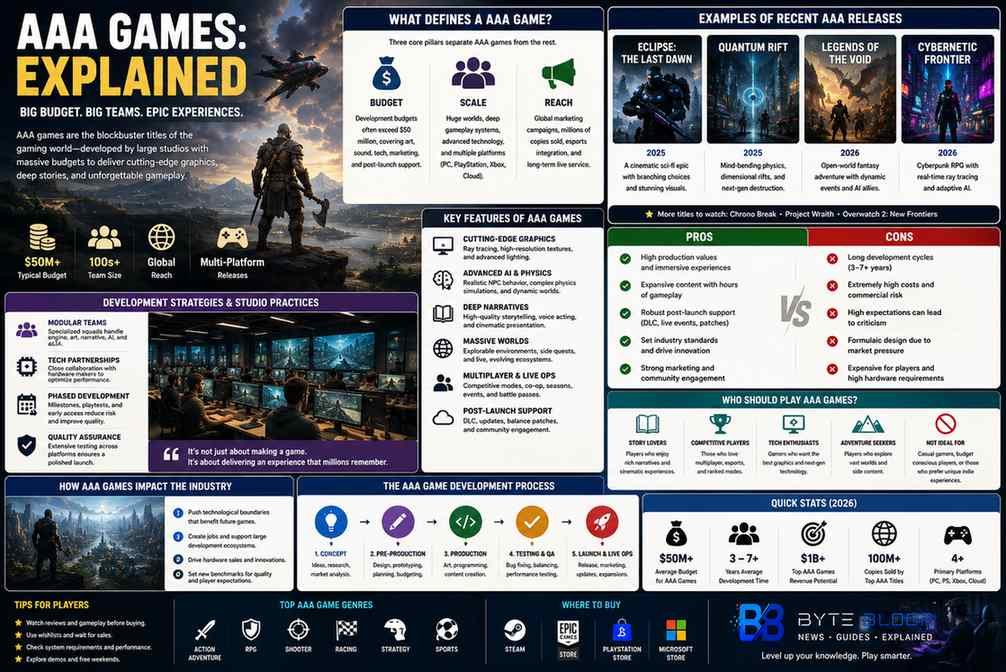
At its core, a AAA game is defined by three pillars: budget, scale, and reach. Production budgets often exceed $50 million, covering art, sound, marketing, and post‑launch support. Scale refers to the scope of the game world, the depth of gameplay systems, and the number of platforms targeted—PC, PlayStation, Xbox, and increasingly cloud services. Reach is measured by global sales targets, marketing spend, and the ability to sustain player engagement through expansions and esports integrations.
Development Strategies and Studio Practices
Large studios adopt a modular approach to manage complexity. Core teams focus on engine development and foundational gameplay mechanics, while specialized squads handle art, narrative, and live‑ops. Studios often partner with hardware manufacturers to optimize performance, as seen with Sony’s PlayStation Studios collaborating on next‑gen console features. Risk mitigation is achieved through phased releases, early access programs, and extensive quality assurance cycles. The result is a polished product that can compete in a saturated market.
Examples of Recent AAA Releases
2025 saw titles like “Eclipse: The Last Dawn” and “Quantum Rift” set new benchmarks in storytelling and physics simulation. In 2026, upcoming releases such as “Legends of the Void” and “Cybernetic Frontier” promise to leverage real‑time ray tracing and adaptive AI, drawing on lessons from earlier blockbusters. These games illustrate how AAA titles continually push technical boundaries while maintaining mass‑appeal narratives.
Pros and Cons of AAA Games
Pros include high production values, expansive content, and robust support post-launch. Cons often involve long development cycles, high expectations, and the risk of commercial failure if sales targets aren’t met. Players may also experience a “cookie‑cutter” feel when many AAA titles adopt similar mechanics to maximize return on investment.
Who Should Play AAA Games?
AAA games appeal to players seeking immersive worlds, cutting‑edge graphics, and polished gameplay. They are ideal for those who enjoy narrative depth and expansive multiplayer ecosystems. However, casual gamers or those on tight budgets might find the price points and system requirements prohibitive. Indie enthusiasts may prefer smaller titles that offer unique experiences without the polish that comes with AAA budgets.
Key Takeaways
- AAA titles are high‑budget projects that set industry standards for graphics and gameplay.
- Large studios use modular teams and phased releases to manage complexity and risk.
- Innovations in AAA games quickly spread to mid‑budget and indie titles.
- Players expect polished, expansive content but may be deterred by high costs and long development times.
- Success hinges on strong marketing, global reach, and post‑launch support.
Frequently Asked Questions
What is a AAA game?
A AAA game is a high‑budget, high‑profile video‑game developed by large studios and backed by major publishers, featuring advanced graphics, expansive worlds, and extensive marketing.
What are the key features of AAA games?
Key features include large production budgets, multi‑platform releases, cutting‑edge technology like ray tracing, deep narratives, and robust post‑launch support such as DLC and live events.
What are the best use cases for AAA games?
AAA games are ideal for players seeking immersive, polished experiences, for studios aiming to showcase new hardware capabilities, and for publishers targeting global markets with high sales potential.
What are the pros and cons of AAA games?
Pros: high production value, expansive content, strong marketing. Cons: long development cycles, high costs, risk of commercial failure, and sometimes formulaic design.
Conclusion
Based on the available information and industry analysis, AAA games represent the apex of video‑game production, blending massive budgets with cutting‑edge technology to deliver immersive experiences that shape industry trends. Their development models, though costly, set standards that ripple through mid‑budget and indie titles, ensuring that innovation remains a constant force in gaming. As studios continue to invest in next‑gen hardware and AI, AAA games will likely remain the benchmark for quality, while also offering a roadmap for smaller developers to elevate their own creations.
Related Reading
- Top 10 Indie Games That Disrupted the Market
- How Ray Tracing Is Revolutionizing Game Graphics