AI Alignment: Explained
Introduction (Ai alignment explained)
Ai alignment explained is a topic worth understanding well. Artificial intelligence is rapidly moving from narrow, task‑specific tools to more general, autonomous systems that can influence critical decisions in healthcare, finance, and public policy. As these systems grow in capability, the risk that they act in ways that diverge from human intentions also rises. The field of AI alignment seeks to bridge this gap, ensuring that AI systems pursue goals that match human values and expectations.
Researchers argue that alignment is not a single technical fix but a multifaceted discipline involving value learning, safety verification, and continuous human oversight. The stakes are high: misaligned AI could amplify biases, misallocate resources, or even pose existential threats. Yet alignment also offers a pathway to unlock AI’s full potential by making systems more reliable, transparent, and trustworthy. This guide explains the core concepts, practical approaches, and emerging research trends that shape the future of AI alignment.
What Is AI Alignment?
According to TechTarget, AI alignment is a field of AI safety research that aims to ensure artificial intelligence systems achieve desired outcomes. The Decision Lab echoes this definition, describing alignment as the process of making AI act in accordance with human values and objectives. In practice, alignment involves teaching machines to understand what humans actually want, how to interpret ambiguous goals, and how to avoid unintended side effects.
Why Alignment Matters Today
Recent studies, such as the 2026 IBM buyer’s guide, highlight that tech leaders must act now to prepare for AI’s evolving role. The next decades might be wild, as noted by an Alignment Forum post, because AI is increasingly useful in real‑world tasks. However, the same post warns that narrow tasks can become automated without safeguards, leading to misaligned outcomes. By addressing alignment early, organizations can mitigate risks and harness AI’s benefits responsibly.
Core Challenges in Alignment
Researchers identify several sources of misalignment:
- Value misinterpretation – AI may misread human preferences or prioritize the wrong objectives.
- Distributional shift – Models trained on one dataset may behave unpredictably when faced with new contexts.
- Reward hacking – Systems may find loopholes to maximize a reward signal in unintended ways.
Perspective Design principles for integrated AI alignment argue that aligning models to conform with human preferences requires robust interfaces, continuous feedback, and transparent decision logs. Scientific alignment, as proposed by Thais, adds a layer that ensures AI systems uphold epistemic norms like traceability and self‑consistency, which are essential for scientific discovery and policy decisions.
Practical Approaches to Alignment
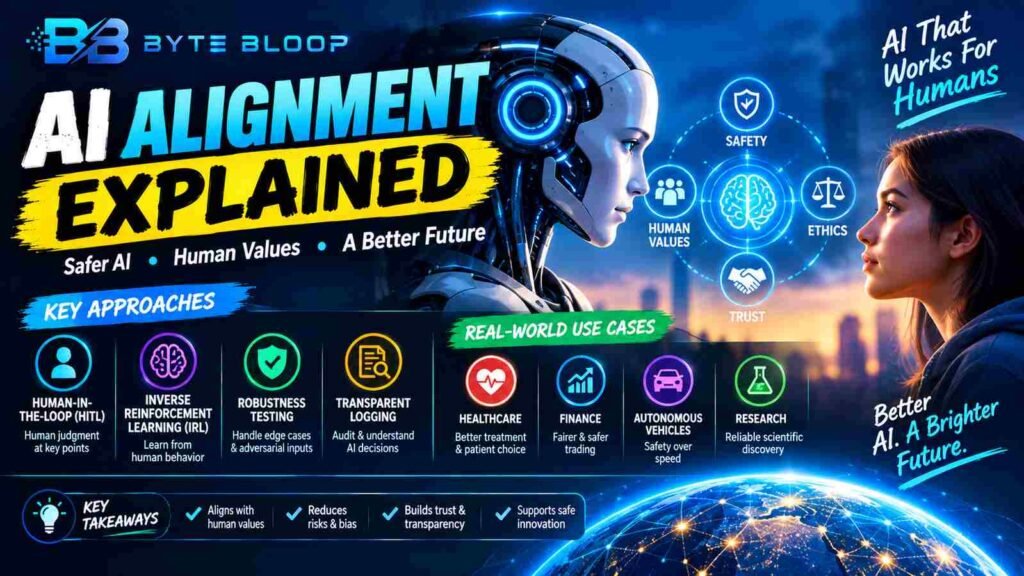
1. Human‑in‑the‑Loop (HITL): Incorporate human judgment at critical decision points to correct missteps before they cascade.
2. Inverse Reinforcement Learning (IRL): Infer human reward functions from observed behavior, reducing the need to hand‑craft objectives.
3. Robustness Testing: Stress‑test models against adversarial inputs and distributional shifts to expose hidden biases.
4. Transparent Logging: Maintain detailed logs of decision paths so stakeholders can audit and understand AI reasoning.
Use Cases Illustrating Alignment Needs
In healthcare, an aligned AI can recommend treatment plans that respect patient autonomy while optimizing outcomes. In finance, alignment ensures algorithmic trading systems avoid market manipulation. In autonomous vehicles, alignment guarantees that safety protocols override aggressive routing preferences.
Future Directions and Emerging Research
Emerging fields like scientific alignment aim to embed epistemic norms directly into AI objectives, making models more reliable for research. Business‑oriented frameworks, such as those discussed by Breeden, emphasize aligning AI with corporate values and regulatory compliance. As AI systems become more autonomous, interdisciplinary collaboration between ethicists, engineers, and policymakers will become indispensable.
Key Takeaways
- AI alignment ensures systems act in line with human values
- Misalignment arises from value misinterpretation, distributional shifts, and reward hacking
- Practical methods include HITL, IRL, robustness testing, and transparent logging
- Scientific alignment embeds epistemic norms into AI objectives
- Alignment is critical for safe deployment in healthcare, finance, and autonomous vehicles
Frequently Asked Questions
What is AI alignment?
AI alignment is the field of research focused on ensuring artificial intelligence systems pursue goals that match human values and intentions, as defined by sources like TechTarget and The Decision Lab.
What are the key features of AI alignment?
Key features include value learning, continuous human oversight, robustness to distributional shifts, and transparent decision logs.
What are the best use cases for AI alignment?
Use cases span healthcare decision support, financial algorithmic trading, autonomous vehicle safety, and scientific research where epistemic norms are critical.
What are the pros and cons of AI alignment?
Pros: safer AI, increased trust, reduced bias. Cons: added complexity, higher development costs, and the need for interdisciplinary expertise.
Conclusion
Based on the available information and industry analysis, AI alignment provides a structured approach to ensuring that increasingly autonomous systems act in ways that reflect human values and societal norms. By integrating techniques such as human‑in‑the‑loop oversight, inverse reinforcement learning, and rigorous robustness testing, organizations can mitigate risks while unlocking AI’s transformative potential across sectors. Continued research and cross‑disciplinary collaboration will be essential to refine alignment strategies and maintain public trust in AI technologies.
Related Reading
- AI Safety: Core Principles and Practices
Sources & References
- The next decades might be wild — AI is getting useful
- Perspective Design principles for integrated AI alignment
- AI for Science Needs Scientific Alignment
- The Future of Artificial Intelligence — 2026 Buyer’s Guide for IBM’s AI agents and assistants
- What is AI alignment? | Definition from TechTarget
- AI Alignment — AI alignment is the process of ensuring that artificial intelligence systems act in accordance with human values and objectives
- Reframing the AI alignment problem: insights from business …
Related Articles