GST Basics: Explained
Introduction
This guide covers gst basics explained in detail. Understanding gst basics explained helps readers make better, more informed decisions.
Goods and Services Tax, or GST, is India’s unified indirect tax that replaced a complex mosaic of state and central duties. Introduced on 1st July 2017, it aims to simplify compliance, broaden the tax base, and create a single national market. For businesses, GST is more than a headline; it determines how you price goods, issue invoices, and claim input tax credit. The tax’s structure—comprising CGST, SGST, and IGST—mirrors
the federal nature of India, while the GST Council continually adjusts rates to balance revenue needs and economic growth. Understanding GST basics is therefore essential for any enterprise, from a sole proprietorship to a multinational subsidiary. This guide distills the core concepts, registration criteria, compliance obligations, and practical tips that will help you navigate the GST landscape confidently. Understanding gst basics explained helps readers make better, more informed decisions.
What Is GST and How Does It Work? — gst basics explained
GST is an indirect tax levied on the supply of goods and services. It operates on a value‑added basis, meaning each business can claim credit for the tax paid on inputs (known as Input Tax Credit or ITC) against the tax due on its outputs. The tax is collected at the point of consumption, and the final consumer bears the cost. The system is built on three pillars: registration, invoice compliance, and return filing. Understanding gst basics explained helps readers make better, more informed decisions.
When Do You Need to Register?
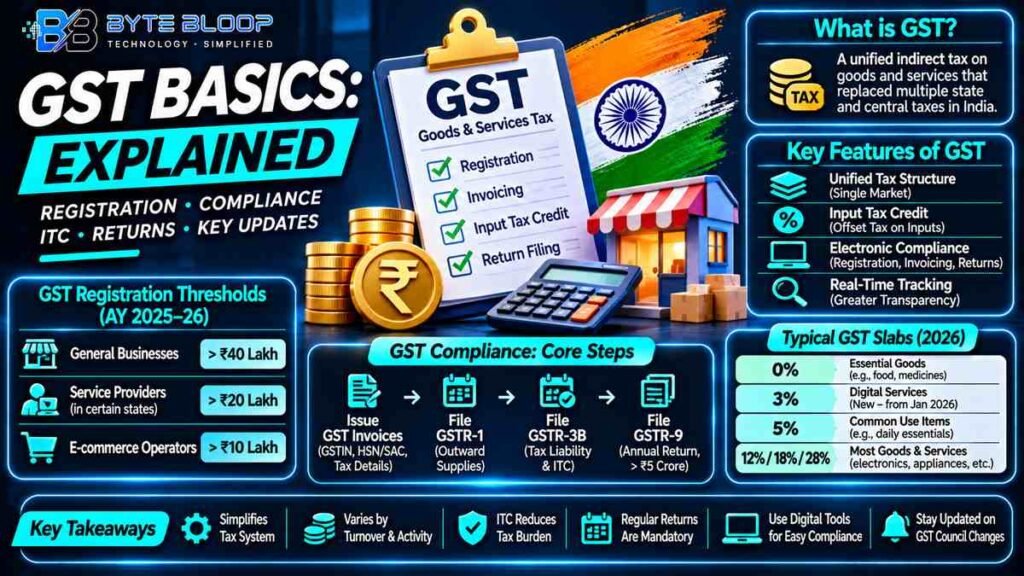
Registration thresholds vary by state and activity. For the Assessment Year 2025‑26, the general turnover limit is ₹40 lakh for most businesses, ₹20 lakh for service providers in certain states, and ₹10 lakh for e‑commerce operators. However, if you engage in inter‑state trade, import goods, or supply services to a government body, registration is mandatory regardless of turnover. The GST Registration Guide for AY 2025‑26 confirms that businesses meeting these thresholds must file Form GST REG‑01 within 30 days of commencement. Understanding gst basics explained helps readers make better, more informed decisions.
Key Features of GST
- Unified Tax Structure – A single tax rate for most goods and services, reducing the cascading effect of multiple taxes.
- Input Tax Credit – Allows businesses to offset tax paid on inputs, preventing double taxation.
- Electronic Compliance – Online registration, invoicing, and return filing through the GST portal streamline processes.
- Real‑Time Tracking – The GST system tracks supply chains, enhancing transparency and reducing tax evasion.
Compliance Essentials
Compliance revolves around three core duties: issuing GST‑compliant invoices, filing monthly/quarterly returns, and maintaining proper records. Invoices must include the supplier’s GSTIN, HSN/SAC codes, and the tax breakdown. The GST portal offers an auto‑populate feature for registered users, reducing manual errors. Monthly returns (GSTR‑1) detail outward supplies, while GSTR‑3B summarizes tax liability and ITC claims. Annual returns (GSTR‑9) consolidate the year’s activity and are required for businesses with a turnover above ₹5 crore. Understanding gst basics explained helps readers make better, more informed decisions.
Practical Example: A Small Retailer
Ravi runs a ₹35 lakh annual turnover shop selling electronics. Because his turnover is below the ₹40 lakh threshold, he is not required to register, but opting for GST registration offers benefits: he can claim ITC on bulk purchases, provide GST‑invoices to customers, and avoid the “tax‑on‑tax” issue that arises when buying from unregistered suppliers. Ravi registers within 30 days of starting operations, obtains a GSTIN, and begins filing GSTR‑1 and GSTR‑3B each month. His compliance costs rise modestly, but the ability to claim ITC improves his cash flow. Understanding gst basics explained helps readers make better, more informed decisions.
Common Challenges and How to Overcome Them
Many businesses struggle with the intricacies of HSN/SAC coding, leading to incorrect tax rates. The GST portal’s auto‑populate feature mitigates this risk. Another hurdle is the frequent rate changes; businesses should subscribe to official notifications from the GST Council to stay updated. Finally, maintaining accurate records is crucial; a digital bookkeeping system integrated with the GST portal can automate data capture and reduce audit risk. Understanding gst basics explained helps readers make better, more informed decisions.
Future Outlook
GST continues to evolve. Recent amendments from 1st January 2026 include revised thresholds for certain service categories and the introduction of a new 3% tax slab for digital services. The ICAI Handbook on Finalisation of Accounts with GST Perspective (June 2026) highlights the importance of aligning accounting practices with GST requirements, ensuring smoother financial reporting. Understanding gst basics explained helps readers make better, more informed decisions.
Key Takeaways
- GST unifies indirect taxes and simplifies compliance.
- Registration thresholds vary by turnover and activity.
- Input Tax Credit reduces tax burden on businesses.
- Regular filing of GSTR‑1, GSTR‑3B, and GSTR‑9 is mandatory.
- Digital tools and auto‑populate features ease invoicing and record‑keeping.
- Staying updated on GST Council changes prevents penalties.
Frequently Asked Questions
What is GST and why is it important for businesses?
GST is an indirect tax on goods and services that replaces multiple state and central taxes. It simplifies pricing, reduces cascading taxes, and allows businesses to claim input tax credit, improving cash flow.
When does a business need to register for GST?
Registration is required if turnover exceeds ₹40 lakh (₹20 lakh for certain services, ₹10 lakh for e‑commerce) or if the business engages in inter‑state trade, imports, or supplies to government bodies, regardless of turnover.
What are the key compliance steps after registration?
Issuing GST‑compliant invoices, filing monthly GSTR‑1 and GSTR‑3B, maintaining accurate records, and submitting annual GSTR‑9 for high‑turnover entities.
What are the pros and cons of GST registration for small businesses?
Pros include input tax credit, improved credibility, and avoidance of tax‑on‑tax. Cons are additional compliance paperwork, potential penalties for late filing, and the need for digital tools.
Conclusion
Based on the available information and industry analysis, GST basics explained reveal that a well‑structured compliance framework not only ensures legal adherence but also enhances business efficiency through input tax credit and streamlined invoicing. By staying informed about registration thresholds, rate changes, and digital tools, businesses can convert GST from a regulatory hurdle into a strategic advantage.
Related Reading
- How to Claim Input Tax Credit: A Step‑by‑Step Guide
This article is for informational and educational purposes only and should not be considered financial, investment, or trading advice.
Related Articles
- nvme vs sata ssd key differences: NVMe vs SATA SSD: Key Differences (2026)
- Worst Essential ai image apps explained: AI Image Apps: Explained | ByteBloop Guide (2026)
- Simple Proven how to use docker step-by-step guide: How to Use Docker: Step-by-Step Guide (2026)
This article is for informational and educational purposes only and should not be considered financial, investment, or trading advice.