Solar Energy: How It Works
Introduction (Solar Energy How It Works)
Solar Energy How It Works is a topic worth understanding well. Solar energy has moved from a niche curiosity to a cornerstone of the global energy mix. In 2026, photovoltaic (PV) panels dominate rooftop installations, while concentrated solar power (CSP) plants scale up in large‑scale deployments. The technology behind these systems is rooted in the photovoltaic effect, a phenomenon discovered over a century ago that turns photons into electrical charge. Today’s panels use advanced silicon heterojunctions, perovskite layers, and tandem cells that push efficiency beyond 30%.
Beyond electricity, solar modules now feed into battery storage, smart grids, and even electric vehicles, creating a resilient, low‑carbon energy ecosystem. Understanding how solar energy works is essential for homeowners, businesses, and policymakers aiming to reduce reliance on fossil fuels and meet climate targets. This guide unpacks the science, technology, and practical considerations of solar power, highlighting the innovations shaping 2026 and beyond.
How Photovoltaic Cells Convert Light into Electricity
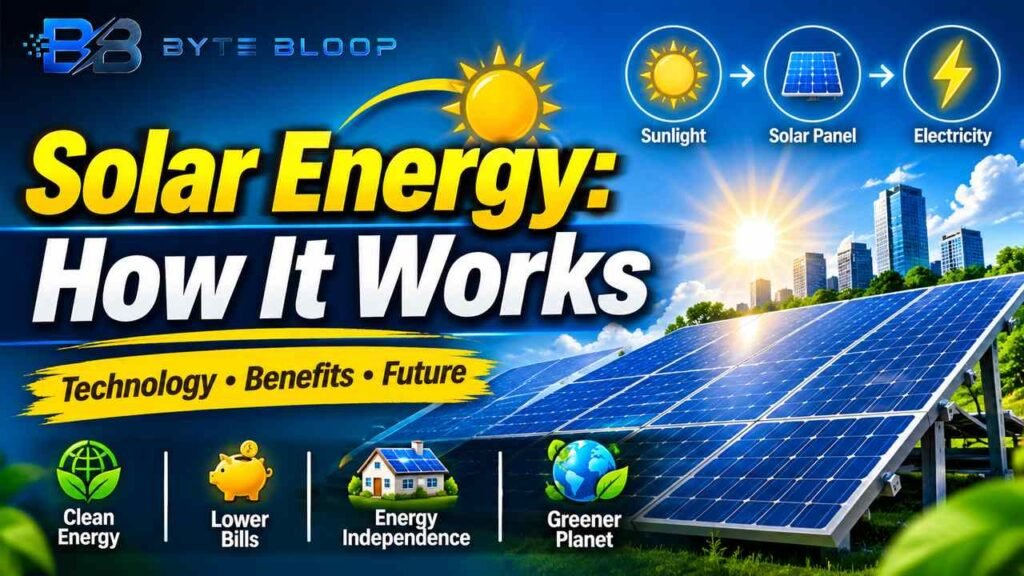
At the heart of every solar panel is the photovoltaic cell. When sunlight strikes the cell, photons are absorbed by semiconductor material—most commonly silicon—creating electron‑hole pairs. An internal electric field, established by doping the silicon with impurities, drives electrons toward the front surface and holes toward the back. Metal contacts on the cell’s surface collect these charges, producing a flow of direct current (DC). According to the Solar Energy Technology overview, two main PV technologies prevail: crystalline silicon and thin‑film panels, each with distinct efficiency and cost profiles.
Crystalline Silicon Panels
Crystalline silicon cells dominate the market, offering efficiencies between 18% and 26% for commercial modules. They are manufactured from high‑purity silicon wafers, either monocrystalline (single‑crystal) or polycrystalline (multiple crystals). Monocrystalline panels, though slightly more expensive, deliver higher performance in limited space scenarios such as residential rooftops.
This matters directly for anyone exploring solar energy how it works.
Thin‑Film Panels
Thin‑film technologies—such as cadmium telluride (CdTe) and copper indium gallium selenide (CIGS)—use a few micrometers of semiconductor material deposited on a flexible substrate. Their lower cost and lightweight nature make them suitable for building‑integrated photovoltaics and large‑scale ground mounts, though they typically lag behind crystalline silicon in efficiency.
Getting solar energy how it works right can make a real difference.
Emerging Technologies Shaping 2026
The latest Solar Panel Technology guide for 2026 highlights several breakthroughs. Perovskite‑based tandem cells, which layer a perovskite absorber on top of silicon, have achieved laboratory efficiencies exceeding 30%. According to the guide, commercial deployment of these cells is expected to accelerate as manufacturing processes mature. Additionally, bifacial modules that harvest light from both sides can boost energy yield by up to 15% in optimal installations.
That is a core part of understanding solar energy how it works.
Concentrated Solar Power (CSP)
CSP uses mirrors or lenses to focus sunlight onto a receiver, generating high‑temperature heat that drives a turbine. The Future of Solar Energy guide notes that CSP with molten‑salt storage can provide dispatchable power, filling the intermittency gap left by PV. In 2026, CSP projects are expanding in desert regions where insolation is highest.
Many readers look into solar energy how it works for exactly this reason.
Solar‑Battery Integration
Energy storage is essential for balancing supply and demand. Lithium‑ion and flow batteries are increasingly paired with PV arrays, enabling time‑shifted consumption and grid stabilization. The What Is Solar Energy in 2026? article highlights that battery costs have dropped 40% over the past five years, making storage a viable add‑on for both residential and commercial systems.
It is worth revisiting solar energy how it works as things develop.
Practical Considerations for Installations
Site assessment remains critical. Factors such as roof orientation, shading, and local climate influence system design. The Solar Energy Technology overview stresses that optimal tilt angles maximize annual output, while advanced monitoring software tracks performance in real time.
Solar Energy How It Works remains highly relevant here.
Cost Trends
According to the What Is Solar Energy in 2026? guide, the levelized cost of electricity (LCOE) for utility‑scale PV has fallen below $0.04 per kWh in many regions, approaching the cost of natural gas in some markets. This trend is driven by economies of scale, improved manufacturing, and policy incentives.
This is a key consideration when it comes to solar energy how it works.
Regulatory Landscape
Feed‑in tariffs, net metering policies, and renewable portfolio standards shape adoption rates. The Future of Solar Energy guide notes that countries with robust incentives see double the installation growth compared to those with limited support.
This matters directly for anyone exploring solar energy how it works.
Future Outlook and Challenges
While solar technology continues to advance, challenges remain. Material scarcity—particularly for rare earth elements used in certain thin‑film cells—could constrain supply. Environmental concerns around end‑of‑life disposal of panels also demand circular economy solutions. Nonetheless, ongoing research, such as the review on solar technology evolution, suggests that next‑generation materials like silicon‑based perovskites and graphene conductors may mitigate these issues.
Getting solar energy how it works right can make a real difference.
Takeaway for Stakeholders
For homeowners, the key is choosing a system that balances upfront cost with long‑term savings, while for businesses, integrating solar with battery storage can unlock operational flexibility. Policymakers should focus on creating stable incentives and streamlining permitting to accelerate deployment.
As the technology matures, solar energy is poised to become a dominant, reliable component of the global energy portfolio.
Key Takeaways
- Photovoltaic cells convert photons into DC electricity via the photovoltaic effect.
- Crystalline silicon panels lead the market with 18‑26% efficiency; thin‑film panels offer lower cost and flexibility.
- Perovskite tandem cells and bifacial modules are pushing efficiencies above 30% and yield gains in 2026.
- CSP with molten‑salt storage provides dispatchable power, complementing PV’s intermittency.
- Battery integration is critical for time‑shifted consumption and grid stability.
- Policy incentives and cost reductions are driving rapid adoption worldwide.
Frequently Asked Questions
What is the basic principle behind solar panels?
Solar panels use the photovoltaic effect, where photons from sunlight excite electrons in a semiconductor, creating an electric current.
That is a core part of understanding solar energy how it works.
What are the key features of current solar panel technologies?
Crystalline silicon panels offer high efficiency and durability; thin‑film panels provide lower cost and flexibility; perovskite tandem cells exceed 30% efficiency; bifacial modules capture light from both sides.
What are the best use cases for solar energy in 2026?
Residential rooftop installations, commercial ground‑mounted arrays, large‑scale CSP plants for grid dispatch, and solar‑battery systems for time‑shifted consumption.
What are the pros and cons of solar energy?
Pros include low operating costs, renewable source, and grid stability with storage; cons involve upfront capital, intermittency, and material supply constraints.
Conclusion
Based on the available information and industry analysis, solar energy in 2026 represents a mature yet rapidly evolving technology that delivers high efficiency, decreasing costs, and versatile applications across residential, commercial, and utility scales. Its integration with battery storage and advanced materials such as perovskite tandem cells positions it as a cornerstone of the global transition toward a resilient, low‑carbon energy future.
Related Reading
- Understanding Solar Panel Efficiency Ratings
Sources & References
- Latest Solar Panel Technology 2026: Trends & Innovation
- Solar Energy Technology – an overview
- Future of Solar Energy: Complete Guide
Related Articles