Zero Trust: Explained
Introduction (Zero Trust Explained)
What Is Zero Trust Architecture?
Zero Trust Explained is a topic worth understanding well. Zero Trust Architecture (ZTA) is a cybersecurity framework that eliminates implicit trust in enterprise environments. It operates on the principle of “never trust, always verify,” demanding strict identity verification for every user, device, and request before granting access. In practice, this means that even if a user is inside the corporate network, they cannot assume they have blanket rights to all resources. Instead, access is granted on a need‑to‑know basis, often with continuous monitoring and micro‑segmentation.
This approach counters the rise of sophisticated attacks that pivot laterally across networks and the growing prevalence of remote work, where traditional perimeter defenses are insufficient. By treating every access attempt as potentially hostile, Zero Trust reduces the attack surface and limits the damage a breach can cause. The model is supported by a range of technologies—multi‑factor authentication, least‑privilege policies, real‑time threat analytics, and adaptive risk scoring—all of which work together to enforce granular controls.
For organizations transitioning from legacy security models, Zero Trust offers a structured path to modernize defenses while maintaining operational agility.
Core Principles of Zero Trust
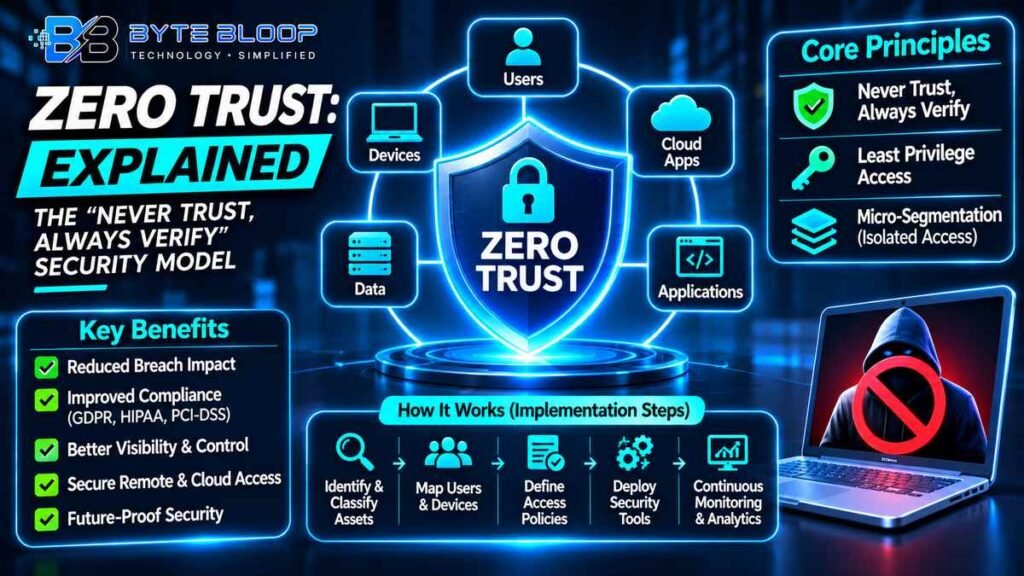
Zero Trust is built around three foundational principles that guide its implementation:
- Never Trust, Always Verify – Every access request is authenticated and authorized, regardless of origin.
- Least Privilege – Users and devices receive only the minimum permissions needed to perform their tasks.
- Micro‑Segmentation – The network is divided into small, isolated zones, so lateral movement is tightly controlled.
These principles are reinforced by continuous monitoring and adaptive risk assessment, ensuring that policies can evolve in real time as threats change.
This matters directly for anyone exploring zero trust explained.
How Zero Trust Works in Practice
Implementing Zero Trust typically follows a phased approach:
Getting zero trust explained right can make a real difference.
- Identify and Classify Assets – Map critical data, applications, and services, then assign sensitivity levels.
- Map User and Device Relationships – Understand who accesses what, from which devices, and under what conditions.
- Define Access Policies – Create rules that enforce least‑privilege and contextual checks (e.g., location, device health).
- Deploy Technology Stack – Use identity‑and‑access management (IAM), multi‑factor authentication (MFA), network segmentation, and endpoint detection and response (EDR).
- Continuous Monitoring and Analytics – Leverage security information and event management (SIEM) and threat intelligence to detect anomalies and adjust policies.
For example, a finance analyst logging in from a corporate laptop in the office will receive access to the budgeting tool after passing MFA and a device health check. If the same analyst logs in from a personal device outside the corporate network, the system may require additional verification or deny access altogether.
That is a core part of understanding zero trust explained.
Benefits of Adopting Zero Trust
Zero Trust offers tangible advantages for modern enterprises:
Many readers look into zero trust explained for exactly this reason.
- Reduced Breach Impact – By limiting lateral movement, attackers find it harder to reach critical assets.
- Improved Compliance – Fine‑grained controls help meet regulatory requirements such as GDPR, HIPAA, and PCI‑DSS.
- Enhanced Visibility – Continuous monitoring provides real‑time insights into user behavior and potential threats.
- Future‑Proofing – The model scales with cloud, SaaS, and remote work, ensuring security remains robust as IT environments evolve.
Challenges and Considerations
While Zero Trust is powerful, organizations must navigate several hurdles:
It is worth revisiting zero trust explained as things develop.
- Complex Implementation – Integrating multiple tools and redefining policies can be resource‑intensive.
- Change Management – Users may resist frequent authentication prompts or stricter access limits.
- Performance Impact – Continuous verification can introduce latency if not properly optimized.
- Cost – Advanced IAM, MFA, and monitoring solutions require investment, though many vendors offer scalable pricing.
Successful Zero Trust adoption hinges on a clear roadmap, stakeholder buy‑in, and a willingness to iterate policies as the threat landscape shifts.
Zero Trust Explained remains highly relevant here.
Key Takeaways
- Zero Trust removes implicit trust, requiring verification for every access request.
- It relies on three core principles: never trust, least privilege, and micro‑segmentation.
- Implementation involves asset classification, policy definition, technology deployment, and continuous monitoring.
- Benefits include reduced breach impact, improved compliance, and enhanced visibility.
- Challenges include complexity, user resistance, performance concerns, and cost.
Frequently Asked Questions
What is Zero Trust Architecture?
Zero Trust Architecture is a cybersecurity framework that eliminates implicit trust, requiring continuous verification for every user, device, and request before granting access to resources.
This is a key consideration when it comes to zero trust explained.
What are the key features of Zero Trust?
Key features include never trust, always verify; least privilege access; micro‑segmentation of networks; continuous monitoring; adaptive risk scoring; and integration of IAM, MFA, and EDR solutions.
What are the best use cases for Zero Trust?
Zero Trust is ideal for organizations with hybrid workforces, cloud‑centric infrastructures, regulated industries, and any environment where lateral movement or insider threats pose significant risks.
What are the pros and cons of Zero Trust?
Pros: limits breach impact, improves compliance, enhances visibility, and scales with modern IT. Cons: implementation complexity, potential performance overhead, user friction, and upfront costs.
Conclusion
Based on the available information and industry analysis, Zero Trust provides a resilient, adaptive security posture that addresses the limitations of traditional perimeter defenses. By enforcing strict verification, least‑privilege access, and continuous monitoring, organizations can significantly reduce the risk of data breaches and meet evolving compliance requirements while supporting modern, distributed work environments.
Related Reading
- Implementing Zero Trust in a Cloud‑First World
- Zero Trust vs. Traditional VPN: Which Is Right for Your Business?
Related Articles